A card that spends bitcoin at the till is clever engineering wearing a simple disguise.
The Card and Balance You Need Before Anything Else
Begin with the checklist, because a crypto debit card only makes sense when every item on it is honestly ticked. First, you need an account with the issuer and a balance of crypto held there, ready to be drawn on. The card does not reach into a private wallet sitting safely at home. It spends from what the issuer holds, which is the single fact that explains most of what follows.
Second, you need the ordinary card basics in place: the physical or virtual card issued, activated, and accepted where you actually shop. In Glasgow that usually means the big card networks, which are taken almost everywhere from supermarkets to small cafes, but acceptance by the network is not the same as suitability for you.
Third, you need a realistic reason to spend crypto at all, rather than ordinary money from a bank account. Fourth, you need the patience for the tax records every purchase creates, covered properly below. Fifth, you need to accept weaker consumer protection than many shoppers assume. If any item on that list gives you pause, the honest answer may be to leave the card in its envelope.
Sixth, keep perspective from traders who live with card costs daily. Anyone who has studied the cheapest way to accept card payments at a market stall learns that payment systems always take their cut somewhere, in fees, in spreads, or in conditions. Spending cards are no different. The cut is simply better hidden.
Tick the list calmly before the card arrives, not after the novelty has you tapping it for everything. A card chosen to solve a real need behaves well. A card chosen for its cleverness tends to create small, expensive habits.
The Conversion Happens at the Till, Not Before
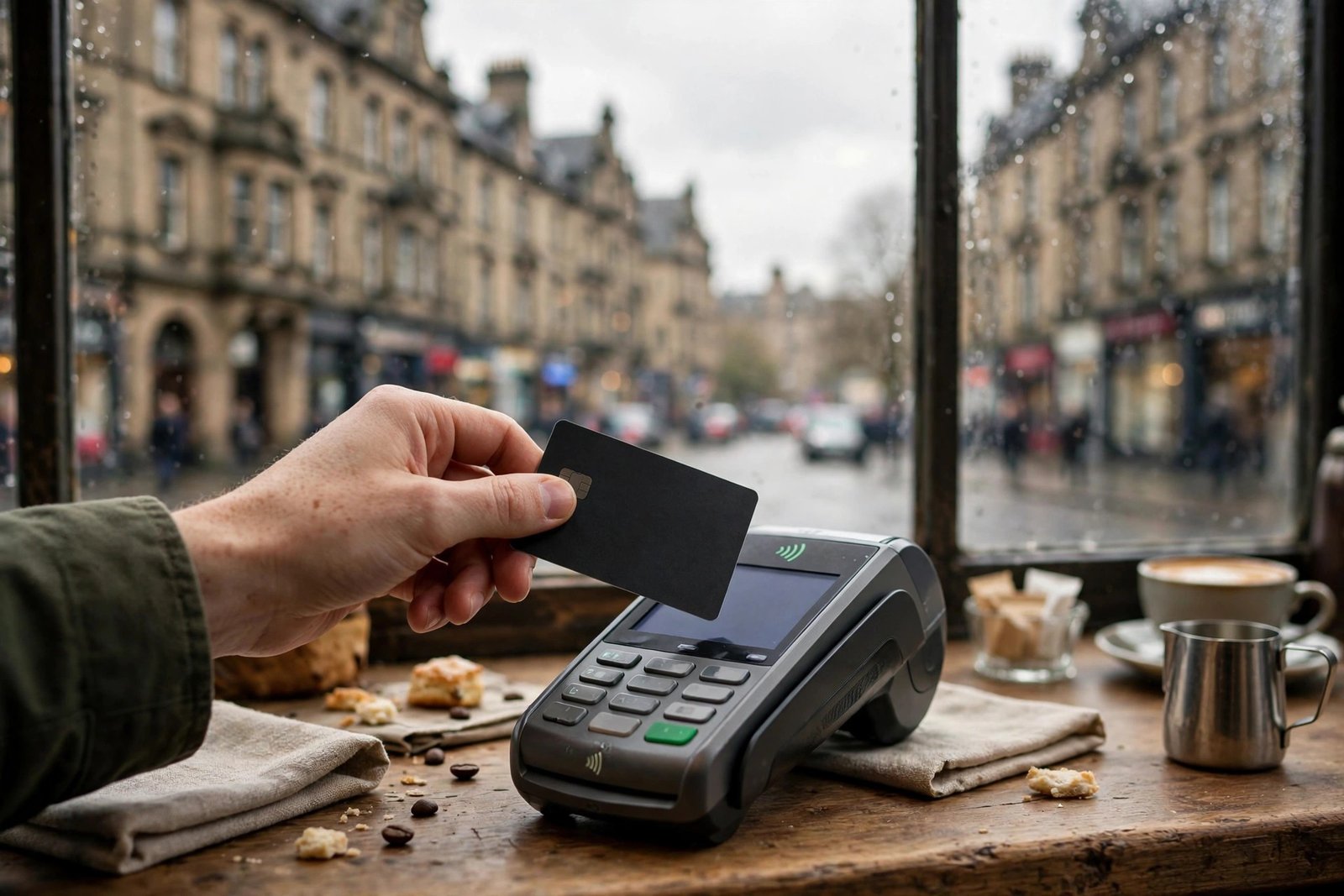
The moment that defines these cards is invisible. You tap at the till in Glasgow, the shopkeeper is paid in ordinary money, and behind that simple tap the issuer sells a little of your crypto, converts the proceeds, and settles the bill. You never hand crypto to the merchant. The merchant may never know crypto was involved at all.
That timing matters. Because the sale happens at the moment of purchase, the price you effectively get is the price at that moment, in that market, through that issuer. You are not spending a balance converted thoughtfully last week at a rate you chose. You are accepting whatever the conversion produces, in real time, while a queue forms behind you.
It also means the card behaves like ordinary plastic in every way you can see. It slots into the same routines as the familiar world of debit cards and how they work, drawing down a balance you already hold rather than borrowing. The difference sits entirely in what the balance is made of, and in everything that follows from that.
Spending a volatile asset on everyday goods creates a quiet oddity worth naming. The coffee bought today is paid for with something whose value may be higher or lower next week. Some holders enjoy that gamble on every purchase. Others find, after a few months, that they prefer spending money whose value stays still and keeping their crypto untouched as a holding rather than a purse.
The Fee Stack, Line by Line
Now the part the marketing prefers to whisper. The first layer is the conversion spread. When the issuer sells your crypto at the till, the rate you receive is rarely the best rate visible elsewhere. The gap between that rate and the headline market price is a cost, charged on every single purchase, and because it is baked into the conversion it never appears as a tidy fee on a statement.
The second layer is travel. Spend abroad and foreign transaction charges can apply, just as they do on many ordinary cards, sometimes alongside the conversion spread rather than instead of it. A card sold as a traveller’s friend deserves especially careful reading on this line, because the fees can quietly return everything the convenience saved.
The third layer is cash. Taking money from a cash machine with one of these cards often carries its own charge, and the same machine that is free for your bank card may not be free for this one. Treat card spending and cash withdrawal as different products wearing the same plastic.
The fourth layer is simply having the card. Some issuers charge for issuing it, replacing it, or leaving it unused for a long stretch. Inactivity fees are the classic buried line: harmless while you are enthusiastic, and a slow leak if the card drifts to the back of a drawer.
None of these charges is scandalous on its own. The stack is the story. Spread on conversion, charges abroad, cash machine fees, and ownership costs can combine into a noticeably expensive way to buy ordinary things. Add up your own likely layers, using your real habits, before deciding that headline rewards make the arithmetic kind.
The Tax Record Every Single Tap Creates
Here is the catch that advisers in this country stress most, and it deserves its own space. For a holder here, spending crypto is a disposal of that crypto. The card turning it into a coffee does not change its nature. A deliberate sale on an exchange and a sandwich bought in Glasgow create the same kind of record-keeping duty, because in both cases crypto left your hands and value was received.
That duty is manageable once and miserable in bulk. Each disposal needs its date, what was spent, and the sterling value at the time, set against what that portion originally cost you, so that any gain or loss can be worked out later. One purchase is a shrug. A year of daily taps is a spreadsheet with hundreds of small lines, each waiting to be matched against purchase records that may stretch back years.
This is why everyday spending is the harshest possible use of the card from a paperwork point of view. A person who sells crypto a few times a year has a few records to keep. A person who buys lunch with it has a tax trail woven through their ordinary life, and the trail does not simplify itself at the end of the tax year.
Practical defences exist. Keep the issuer’s statements and exports, downloaded regularly rather than hunted for later. Consider whether everyday spending should run through ordinary money while crypto stays in its own, tidier lane. And take proper advice if the amounts grow, because the rules are real even when the purchases were small and casual.
Ignore this section and the card’s true price arrives later, in an evening of reconstruction and a lingering worry that the figures are wrong. Attend to it from the first tap and it stays what it should be: a chore, not a crisis.
Protection Gaps Worth Knowing in Advance
Shoppers in this country are used to payment protection working quietly in the background, especially the strong cover that comes with credit cards on larger purchases. A crypto debit card is not a credit card, and assuming the same safety net exists is one of the easiest mistakes a new holder can make. Spending from a balance you own carries a different, thinner set of protections.
There is also the balance itself to consider. Because the card spends from crypto held by the issuer, that holding carries platform risk for as long as it sits there. If the issuer fails or freezes accounts, the money funding your daily spending is caught in the same trouble as any other balance on the platform. Keeping only a spending amount with the issuer, rather than a whole holding, limits that exposure sensibly.
Disputes deserve a thought as well. Ordinary card payments can often be challenged through well worn routes when goods never arrive or a trader vanishes. Those routes exist in weaker forms, or not at all, in parts of the crypto world, and the conversion at the till makes the trail harder to unpick. For a train ticket this may not matter. For a large purchase from an unfamiliar seller, it should.
Where the Card Genuinely Earns Its Place
After the warnings, fairness demands the genuine cases, because they do exist. The strongest is travel. For someone already holding crypto, spending abroad through a card that handles conversion automatically can be simpler than juggling exchanges, transfers, and foreign bank accounts. The quiet rise of contactless payment and its history made tapping abroad feel effortless, and these cards borrow that ease for a different kind of balance.
A second real case is the person whose income or savings already live partly in crypto and who accepts the tax chores as the known price of convenience. For them the card removes a step rather than adding a novelty. The records still matter, but the spending itself matches how their money is already arranged.
A third, narrower case is simple separation. Some holders like a distinct card for online purchases or subscriptions, funded with a limited balance, so that a leak or a fraud attempt can only reach what they placed there. That is a budgeting and safety habit more than a crypto statement, and it works on its own modest terms.
The Glasgow Verdict for Everyday Spending
So, for everyday spending in Glasgow, the verdict is narrow. For most people, most days, ordinary money on an ordinary card remains cheaper, simpler, and kinder at tax time than spending a volatile asset through a conversion at every till. The city’s shops take normal cards perfectly well, and no queue at a supermarket checkout has ever been improved by a hidden crypto sale behind the tap.
The card comes into its own at the edges: travel where conversion is handled simply, holders whose money already lives in crypto and who keep their records willingly, and small, deliberate uses where the limits are understood. In those lanes it is a neat piece of engineering doing exactly what it promises.
Run the checklist once more before deciding. Balance held with the issuer, understood. Conversion at the till, accepted. Fee stack added up, honestly. Tax record for every tap, kept. Protection gaps, known. Reason for using it, real. A card that survives that list has earned its place in your wallet. One that does not can stay an interesting idea, admired from a safe distance, while your everyday spending rides on rails built for it.