
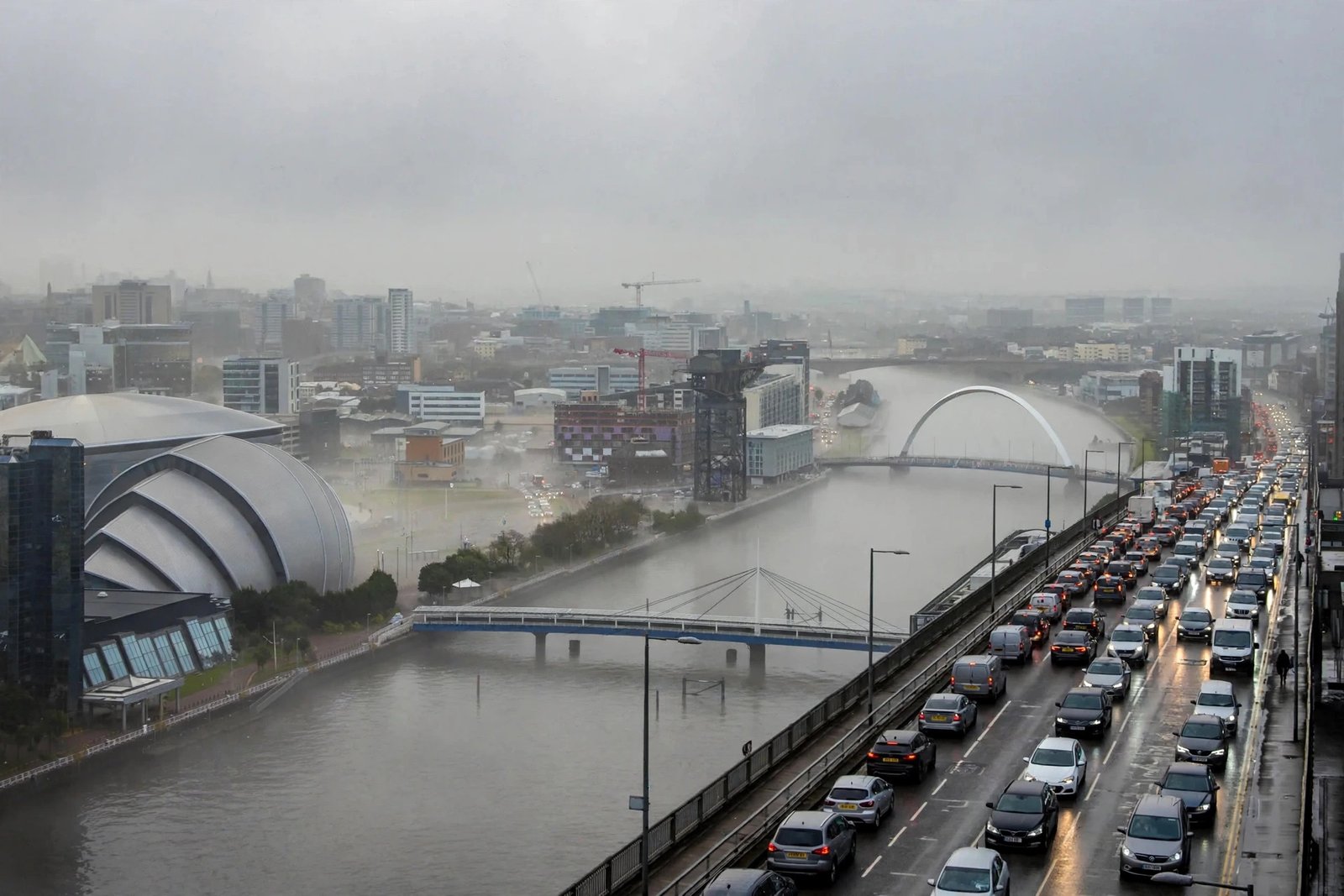
Glasgow has a air-quality story with real plot twists. In 2023 it became the first Scottish city to enforce a Low Emission Zone across its centre — older, more polluting vehicles are now fined for entering. Meanwhile, the city’s air routinely meets most legal limits, yet thousands of Glaswegians still breathe air that the World Health Organization considers unhealthy. Understanding local air quality — what is actually in the air on Buchanan Street versus Bearsden, what it costs to find out, and what you can do about it — is more practical and more interesting than most people expect. And in Glasgow specifically, much of the information is free.
What’s Actually in Glasgow’s Air
Air pollution is not one thing. The pollutants that matter locally:
- Nitrogen dioxide (NO2): Glasgow’s headline problem — produced mainly by diesel vehicles. Historically exceeded legal limits on Hope Street and other canyon-like city-centre streets, which is what triggered the LEZ. Levels have fallen significantly since enforcement began.
- Particulate matter (PM2.5 and PM10): tiny particles from traffic, domestic wood burning, construction and industry. PM2.5 is the most health-damaging — small enough to enter the bloodstream. Glasgow meets UK legal limits but exceeds WHO guidelines, as does nearly everywhere in the UK.
- Ozone (O3): a summer problem, formed when sunlight cooks traffic pollution — paradoxically often higher in suburbs and surrounding countryside than the city centre.
- Domestic burning: wood stoves — fashionable, cosy, and a surprisingly large source of PM2.5. A single wood-burning stove can emit as much particulate matter as hundreds of modern cars; Glasgow’s tenement flats with new stoves are a growing contributor.
The health stakes are not abstract: the Defra-commissioned evidence links long-term PM2.5 exposure to heart disease, stroke, lung cancer and childhood asthma development. Air pollution contributes to an estimated 1,700–2,500 early deaths a year in Scotland. But — crucial perspective — Glasgow’s air is far cleaner than it was in the industrial era, and far cleaner than most global cities. The question is not “is it safe or dangerous” but “where, when, and for whom does it matter?”
The Free Tier: Understanding Costs £0
Here is the pleasant surprise: understanding Glasgow’s air quality costs nothing, because the monitoring infrastructure is public:
- Defra’s UK-AIR: uk-air.defra.gov.uk — the national network, with Glasgow monitoring stations (Hope Street, Great Western Road and others) reporting hourly. Free, authoritative, and the data behind every headline.
- Glasgow City Council: publishes its air quality annual reports and real-time data; the council’s website maps the LEZ boundary and its measured impact.
- Scottish Air Quality: scottishairquality.scot — Scotland-specific forecasts, including the daily air quality index by region.
- addresspollution.org: free postcode-level pollution estimates for any UK address — genuinely useful when house-hunting.
- Apps: free apps (Plume, AirVisual) give street-level forecasts using modelled data.
Learning to read the Daily Air Quality Index (1–10, banded Low/Moderate/High/Very High) takes ten minutes and converts abstract worry into practical decisions: on High days, shift your run to the park away from roads, keep asthmatic children’s reliever inhalers handy, and avoid strenuous exercise beside busy roads.
The Paid Tier: When Monitoring Gets Personal (£20–£250)
Public stations are kilometres apart; your street may differ. Personal options:
- DIY sensors (£20–£40): basic PM2.5 sensors (the popular Plantower-based builds) give indicative indoor/outdoor readings — good enough to compare rooms, test the effect of closing windows at rush hour, or check whether the new wood stove is spiking your living room. Accuracy is indicative, not regulatory.
- Consumer monitors (£150–£250): devices like the IKEA VINDSTYRKA (~£35, remarkably good for the price) or dedicated units (AirGradient ~£150, Temtop ~£150) measure PM2.5, and some add CO2, VOCs and humidity — the indoor picture, which matters because we spend ~90% of our time indoors.
- Radon testing (£30–£50): not air pollution in the classic sense, but Glasgow’s geology means some areas have elevated radon — a colourless gas and the second-biggest cause of lung cancer. UKHSA’s radon maps show affected postcodes; a two-detector test kit is the definitive check.
For most people, the free public data plus a £35 indoor sensor is the sweet spot — total outlay under £40 for a genuinely useful personal picture.
What You Can Actually Do About It
Understanding is only half the value; the actions, ranked by impact:
Route choice: walking or cycling one street back from a main road can halve your pollution exposure — pollution drops sharply with distance from traffic. Glasgow’s growing cycle network (the South City Way, the lanes to the universities) doubles as low-pollution commuting. Affordable UK train travel covers the longer journeys.
Timing: pollution peaks at rush hours; shifting exercise or school-run walking by 30–60 minutes measurably reduces exposure. Check the morning forecast like weather.
Home: ventilate strategically (mornings before rush hour, or via back-street-facing windows), use extractor fans when cooking (gas hobs are a major indoor NO2 source — the extractor is not optional), and think twice about the wood stove — if you have one, burn only dry seasoned wood (Ready to Burn certified), never burn in the smoke control area without an exempt appliance, and know it dominates your household’s particulate footprint. Cutting heating bills without resorting to smoky fuels is the win-win.
Travel: the LEZ means your 2014 diesel cannot enter the city centre — check compliance free on the council site before risking the £60 fine (halved if paid in 14 days). Buses, the Subway, and the cycle hire scheme are the compliant defaults.
Conclusion: The Real Cost
How much does understanding local air quality really cost in Glasgow? £0 for the public picture — Defra’s hourly data, the council’s reports, the Scottish forecasts, the postcode estimators — which is genuinely enough for 90% of decisions. £35–£150 for the personal layer if you want your street and your living room measured. The expensive part was never the information; it is the optional life changes (the EV, the house move to a cleaner street) — and even there, the free knowledge tells you whether they are worth it. Check uk-air.defra.gov.uk today, learn your street’s story, and breathe a little easier — or at least, a little more informed.
Frequently Asked Questions
Is Glasgow’s air actually bad?
By UK legal standards: mostly compliant now, largely thanks to the LEZ cutting city-centre NO2. By WHO health guidelines: still above recommended levels for PM2.5, like nearly all UK cities. Direction of travel: improving, significantly, over the last decade. It is a “much better, not yet good enough” story.
What is the Glasgow Low Emission Zone and does it affect me?
Since June 2023 (enforcement from 2024 for residents’ grace period end), non-compliant vehicles face £60 fines for entering the city-centre zone. Petrol cars generally need Euro 4 (roughly 2006+), diesels Euro 6 (roughly 2015+). Check your reg free on the council’s vehicle checker. Blue badge holders and some categories are exempt.
Are wood-burning stoves really that polluting?
Yes — domestic combustion is now one of the UK’s largest sources of PM2.5. Defra data attributes a large share of particulate emissions to domestic burning, and a single stove can dominate a street’s local levels on a still winter evening. If you burn, use only dry wood in an exempt appliance within smoke control areas (most of Glasgow is one), and never burn treated waste wood.
Should I wear a mask on high-pollution days?
For most people, no — the official advice is to reduce exertion near busy roads and follow health guidance if you have asthma or heart conditions. Well-fitted FFP2/FFP3 masks do filter PM2.5 and are reasonable for vulnerable people on Very High days or for cyclists on the most polluted corridors, but they are not routine advice.
Where exactly are Glasgow’s monitoring stations?
The automatic network includes city-centre (Hope Street area), Great Western Road, and others — all reporting hourly to UK-AIR. The council’s annual Air Quality Status Reports detail every site and the trends. If your street is not monitored, the modelled postcode estimators (addresspollution.org) fill the gap credibly.


