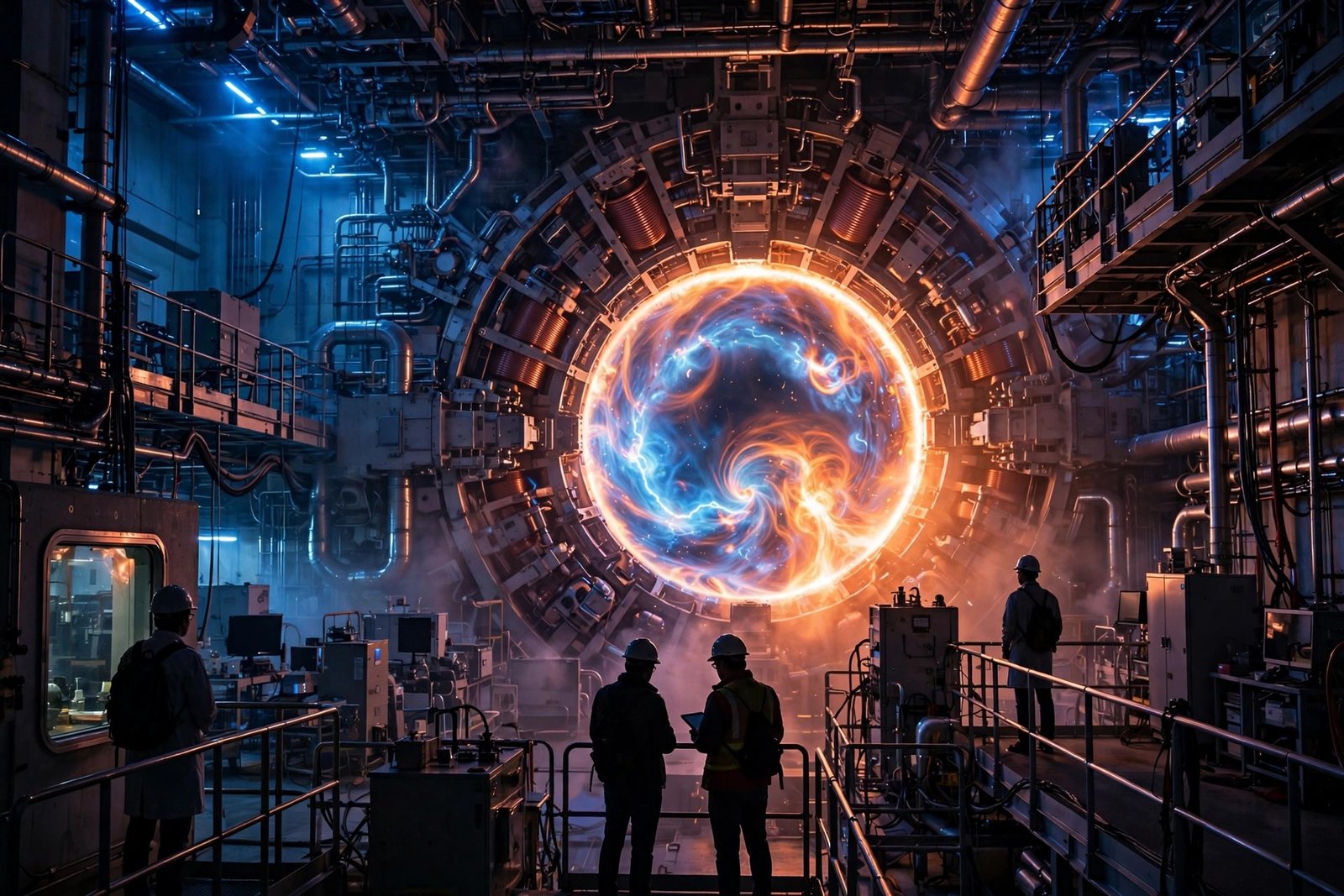
Every few months, another headline announces that nuclear fusion — the process that powers the sun — is one step closer to lighting up our homes. In 2022, British scientists at the JET facility in Oxfordshire set a world record for fusion energy output. In 2024, researchers kept plasma burning longer and hotter than ever before. If you have watched these stories roll by and wondered whether it is worth your time to actually understand what is going on, this guide is for you.
The honest answer: yes, but not for the reasons you might think. Understanding fusion progress is worth it for a beginner not because fusion will power your kettle next year — it will not — but because it teaches you how science actually moves: in decades, not headlines. Here is a beginner-friendly tour of what fusion is, where it really stands in 2026, and whether following it deserves a slice of your attention.
What Nuclear Fusion Actually Is (In Plain English)
Forget the equations. Fusion is what happens when two very light atoms — usually forms of hydrogen — are squeezed together so hard that they merge into a heavier atom. When they merge, a tiny bit of mass vanishes, and that missing mass becomes an enormous amount of energy. It is the same reaction burning in the core of the sun, where temperatures reach 15 million degrees Celsius.
The appeal is obvious. The fuel — hydrogen extracted from seawater — is effectively limitless. The process produces no carbon dioxide and no long-lived nuclear waste. A bathtub of seawater could, in theory, power a city. The catch is equally obvious: on Earth, squeezing atoms together requires temperatures ten times hotter than the sun’s core and magnetic “bottles” of extraordinary precision, because no physical material can touch plasma that hot without vaporising.
That gap between the elegant idea and the brutal engineering is the entire story of fusion. Every breakthrough you read about is a small closing of that gap.
Where Fusion Progress Really Stands in 2026
Here is the state of play, stripped of hype. Scientists measure fusion progress with a concept called Q — the ratio of energy out to energy in. For decades, Q sat stubbornly below 1, meaning experiments consumed more energy than they produced. In December 2022, the US National Ignition Facility achieved “ignition”: a Q greater than 1, producing about 3.15 megajoules from 2.05 megajoules of laser energy. It was a genuine landmark — proof the physics works.
Since then, progress has been steady but incremental: longer plasma confinement times, stronger superconducting magnets, better control systems. The UK’s STEP programme — Spherical Tokamak for Energy Production — aims to build a prototype fusion power plant, with the UK Atomic Energy Authority leading Britain’s fusion effort from its Culham site in Oxfordshire. Private companies have poured billions into competing designs, from compact tokamaks to entirely new confinement ideas.
But — and this is the part headlines skip — ignition in a lab is not a power station. The NIF result produced enough energy to boil a kettle a few times, cost an enormous facility to achieve, and cannot run continuously. The credible expert consensus, including the international ITER project in France, places grid-scale fusion power in the 2040s at the earliest, and even that assumes no major setbacks.
Why It Is Worth Understanding Anyway
So why should a beginner bother? Three reasons.
First, fusion is a masterclass in how science works. Following it teaches you to read past the headline. When a story says “fusion breakthrough,” you will know to ask: was this net energy gain for the plasma, or for the whole facility? (They are very different.) Did it run for seconds or sustain itself? This critical lens transfers to every science story you will ever read — from BBC science coverage to medical research.
Second, it connects to things you already care about. Fusion is ultimately an energy story, and energy is a bills story. Understanding why baseload power matters, what “the grid” actually does, and why renewables plus storage plus (eventually) fusion is the likely mix makes you a far better-informed citizen — and helps you make sense of practical steps like energy-saving upgrades for an old house or cutting energy bills for a small business.
Third, it is genuinely awe-inspiring. There is real intellectual pleasure in understanding how humans learned to bottle a star. Few beginner science topics deliver that feeling as reliably as fusion.
What Is Not Worth Your Time
A word of caution: the fusion space attracts hype merchants. Be sceptical of any company promising commercial fusion “within three years” — that claim has been made, and missed, for decades. Be equally sceptical of social media accounts that present every minor experiment as the moment everything changed. The reliable sources are the national labs, ITER, and established science journalism. If a claim does not appear in those places, treat it as marketing.
Also, do not fall into the trap of learning fusion trivia instead of fusion understanding. Knowing the names of five reactor designs impresses nobody if you cannot explain, in one sentence, why fusion is hard. (Answer: containing something hotter than the sun’s core without touching it.) Depth on the core ideas beats breadth on the details.
How a Beginner Can Follow Fusion Sensibly
You do not need a physics degree. A sensible beginner’s approach takes about two hours total: read one good explainer on how tokamaks work, watch one documentary segment on the JET record, and bookmark one reliable news source for occasional updates. After that, check in every few months — fusion moves slowly enough that weekly following is wasted attention.
If you want to go one step deeper, learn the three numbers that matter: plasma temperature (aiming for 150 million °C), confinement time (how long the plasma stays stable), and Q (energy out versus energy in). Every genuine milestone is an improvement in one of those three numbers. Everything else is commentary.
The Bottom Line
Is understanding nuclear fusion progress worth it for a beginner? Yes — as a two-hour investment that pays off in scientific literacy, energy awareness, and sheer wonder. It is not worth obsessing over daily, and it will not change your life this decade. But the next time a fusion headline flashes across your screen, you will be one of the few people who actually knows what it means. That is worth a beginner’s time.
Frequently Asked Questions
Will nuclear fusion power my home in the next ten years?
Almost certainly not. The expert consensus places the first grid-connected fusion power in the 2040s at the earliest. Fusion is a mid-century energy source, not a near-term one.
What was the big 2022 fusion breakthrough?
The US National Ignition Facility achieved scientific ignition — the first controlled fusion experiment to produce more energy from the fuel than the lasers delivered to it. It proved the physics works, but the result was tiny in absolute terms and not repeatable as a power source.
Is the UK involved in fusion research?
Deeply. The UK Atomic Energy Authority at Culham in Oxfordshire is one of the world’s leading fusion centres, the JET facility set multiple world records there, and the UK’s STEP programme aims to build a prototype fusion power plant.
How is fusion different from the nuclear power we already have?
Existing nuclear plants use fission — splitting heavy atoms like uranium. Fusion merges light atoms like hydrogen. Fusion produces no long-lived radioactive waste and cannot melt down in the way fission plants can, but it is far harder to achieve.