Your seed phrase is twelve or twenty-four ordinary words, and it is also the entire key to your crypto. Whoever holds those words holds your money — no password reset, no customer service, no second chances. So the question of whether securing your seed phrase offline is “actually worth it” for a beginner has a short answer and a longer one. The short answer: yes, overwhelmingly. The longer answer explains what offline security really means, why digital storage keeps failing people, and how to do it properly without turning your home into a bunker.
You will learn what a seed phrase actually controls, the real-world ways beginners lose theirs, the three tiers of offline storage from free to serious, the mistakes that defeat the whole exercise, and a simple setup you can complete this weekend.
What your seed phrase actually is
A seed phrase (recovery phrase) is a human-readable backup of your wallet’s private keys, generated when you first create the wallet. From those words, every address and key in the wallet can be mathematically reconstructed. That is its genius and its danger: the phrase is the wallet. Lose it and a broken phone means your crypto is gone forever. Expose it and a stranger anywhere in the world can empty your accounts in minutes.
Beginners often misunderstand the threat model. The risk is not just hackers in hoodies; it is screenshots backed up to cloud photo libraries, notes apps syncing to servers, a “helpful” email to yourself, a photo of the phrase sitting in your camera roll. Every digital copy is a copy that can be stolen at scale, silently, from anywhere. Offline storage exists to take your keys out of that game entirely.
How beginners actually lose their seed phrases
The loss stories follow depressingly familiar patterns. The cloud backup: someone photographs their phrase “just temporarily” and it syncs to iCloud or Google Photos, where a later account breach hands it to a thief. The helpful digital note: the phrase lives in a notes app, an email draft, or a password manager’s secure note — better than plaintext, but still one breach away from exposure, and password managers are designed for passwords you can rotate, not keys you cannot.
Then there is the social engineering route: fake wallet apps and support scams that ask you to “verify” or “migrate” by entering your phrase. No legitimate software ever needs your seed phrase except during a genuine restore that you initiated on a device you trust. And finally, plain loss: the scrap of paper thrown away in a clear-out, the notebook lost in a house move, the single copy destroyed by a washing machine or a house fire. Each of these has happened thousands of times. Offline does not mean a sticky note — it means deliberate, redundant, physical storage.
Tier 1: paper, done properly (free)
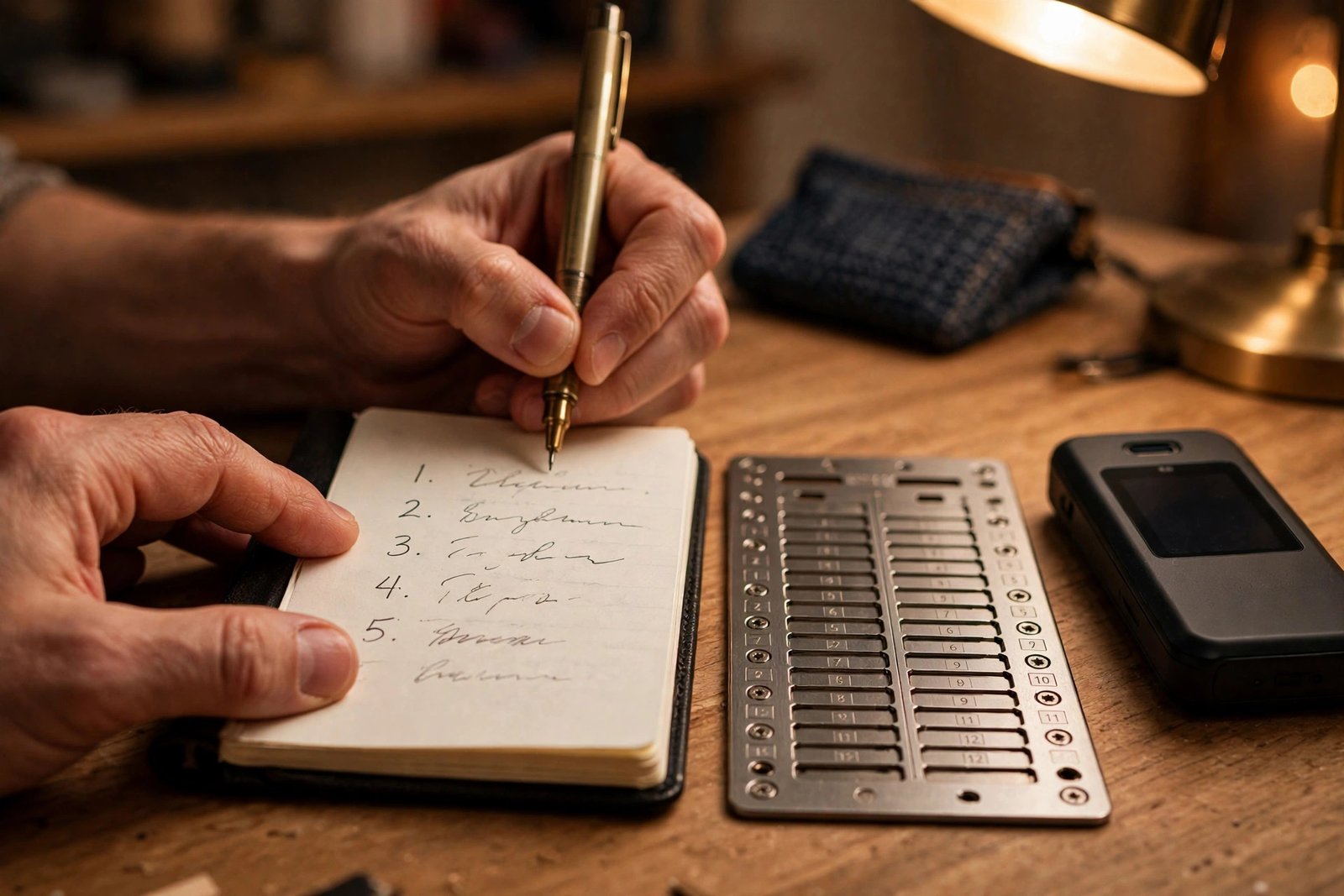
For most beginners, two paper copies stored in two separate secure locations is a completely respectable setup. Write the words by hand, clearly, in order, with a pen that will not fade — cheap ballpoints on thin paper are how “word 14 is illegible” disasters start. Number each word. Double-check every word against the wallet’s word list; a single wrong word makes the backup useless.
Store the copies somewhere genuinely separate: one at home in a fire-resistant document bag or safe, one with a trusted person or in a second location like a safe deposit box. Separation protects against fire, flood, and burglary hitting both copies at once. Never photograph the paper, never type the words into anything, and never tell anyone the full contents — the trusted person holding your backup should ideally not know what it is, just that it is important documents. This tier costs almost nothing and defeats every remote attack completely. A thief in another country cannot steal paper from your drawer.
Tier 2: metal backup plates (£30–£80)
Paper burns, dissolves, and fades. Metal seed-phrase plates — small steel or titanium tablets into which you stamp or engrave each word — survive house fires, floods, and decades of neglect. They cost roughly £30 to £80 from reputable manufacturers and take an evening to set up with a hammer and letter stamps.
Metal is worth it when your holdings have grown past “annoying to lose” into “life-changing to lose.” The same two-location rule applies: split plates or duplicate plates in separate places. One advanced option is splitting the phrase across locations so no single site holds the complete key — but only attempt this if you fully understand the scheme, because a lost share can mean a lost wallet. For most people, two complete metal copies in two places is the sweet spot of safety and simplicity. Whatever tier you choose, the discipline of keeping secrets offline has cousins in everyday digital hygiene — choosing a safe password manager for the family handles the secrets you can rotate, while your seed phrase stays firmly in the physical world.
Tier 3: multi-signature and inheritance planning (serious holdings)
Once crypto becomes a meaningful part of your net worth, a single seed phrase — however well stored — is a single point of failure, including the failure mode nobody likes to discuss: you. Multi-signature wallets require two or more keys to authorise a transaction, so one lost or stolen key is not catastrophic. Hardware wallets from established manufacturers, used with passphrases and stored separately, form the backbone of this tier.
Equally important is inheritance. If something happened to you tomorrow, would your family know the crypto exists, where the backups are, and how to access them — without the instructions themselves becoming a security hole? A sealed letter with a solicitor, or clear instructions left with someone you trust utterly, is part of responsible ownership. This is not paranoia; it is the adult version of having a will. The FCA’s cryptoasset guidance is blunt that consumers should be prepared to lose everything — proper key management is how you make sure “everything” does not include losses that were preventable.
The mistakes that defeat the whole exercise
Laminating your paper backup and then photographing it “for the records” undoes everything. Storing both copies in the same house undoes the redundancy. Telling friends at the pub about your “crypto vault” undoes the secrecy. Using a printer to print the phrase creates a digital copy in the printer’s memory — hand-write it. And the classic: “verifying” your wallet on a website that asked for the phrase. There is no verification process that needs it. Ever.
Also resist cleverness. Encrypting the phrase and storing the password “somewhere safe” just moves the problem. Splitting words across five hiding spots you will forget is not security, it is a treasure hunt your future self will lose. Simple, redundant, physical, secret — that is the whole doctrine. If your broader digital life needs the same treatment, learning how to back up your phone photos properly is a good parallel exercise in thinking about what “backed up” really means.
Conclusion
Securing your seed phrase offline is not just worth it for a beginner — it is the highest-return security action in all of crypto. Fifteen minutes with pen and paper, stored in two separate places, permanently removes the largest category of theft and loss from your life. Digital convenience is wonderful for almost everything else. For the twelve or twenty-four words that are your money, paper and metal win, and they win forever.
Frequently Asked Questions
Can I store my seed phrase in a password manager?
It is far better than plaintext, but password managers are built for rotatable passwords, and a cloud vault is still a remote target. For meaningful holdings, physical offline storage is the stronger choice.
What happens if someone finds my paper backup?
They can take everything, which is why storage location secrecy matters as much as the backup itself. Consider whether the holder of a backup needs to know what it is.
Should I split my seed phrase across multiple locations?
Only with a proper scheme you fully understand. Two complete copies in two separate secure places is simpler and safer for most beginners than amateur splitting.
Does my family need to know about my crypto?
Someone you trust should know it exists and how to access it if you cannot — via a solicitor or sealed instructions, not via a text message. MoneyHelper has free guidance on wider estate-planning basics.