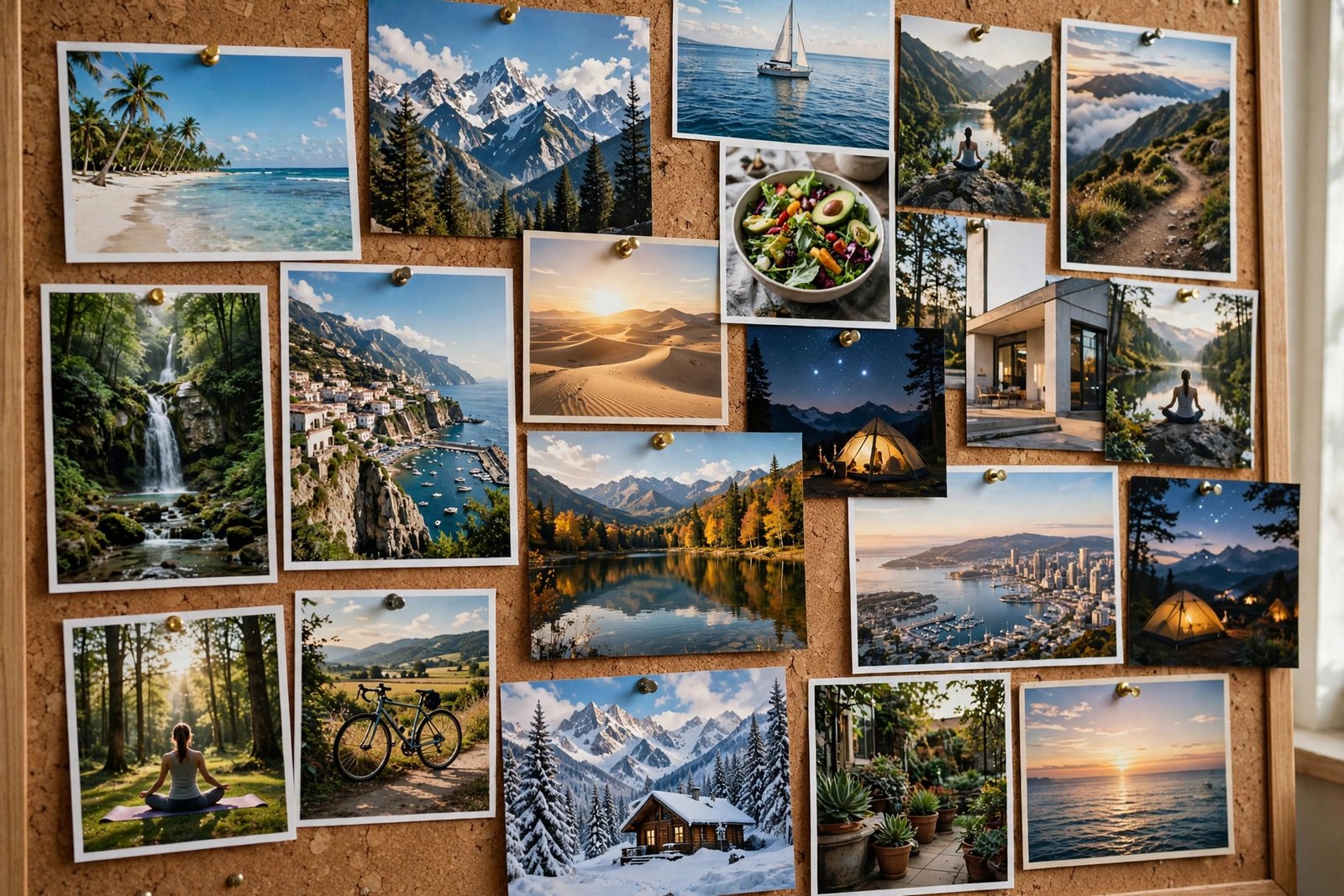
Vision boards have a credibility problem. Too often they are presented as manifestation magic — stick a Ferrari on cardboard and the universe delivers — which invites deserved scepticism and misses the genuinely useful psychology underneath. Stripped of mysticism, a vision board is a visual goal-clarification and attention-priming tool, and the research on visualisation, goal-setting and selective attention says it can work — if built correctly. Here is how to create one that actually does something.
Why Vision Boards Can Work (The Real Psychology)
Three established mechanisms, none of them magical. Goal clarification: the process of choosing images forces you to articulate what you actually want — most people have never done this concretely, and vague goals (“be happier”, “get fit”) produce vague efforts. Selective attention (the reticular activating system): your brain filters massive sensory input by relevance; priming it with your goals makes you notice relevant opportunities, people and information you would otherwise walk past. The “red car phenomenon” — you see your car model everywhere after buying it — is the same machinery pointed at your ambitions.
Implementation priming: visualisation research (across sports, music and surgery) shows that mental rehearsal of processes improves performance — but crucially, visualising the process, not just the outcome. Athletes who visualise the race, stroke by stroke, improve; those who only visualise the medal do not. This distinction is the entire difference between vision boards that work and vision boards that are daydream collages. For the goal-setting frameworks that pair with this, personal development podcasts offer ongoing reinforcement, and a solid morning routine gives the board a daily viewing slot.
Building It Right: The Process-Focused Method
Step 1: Clarify before you cut. Write down 3–5 goals for the next 12 months, specific enough to photograph: not “better health” but “running the Bristol 10k”; not “more money” but “£5k emergency fund”. Vague goals make vague boards make vague results.
Step 2: Images of process, not just prizes. For each goal, include images representing the outcome AND the process: the finish line and the training shoes; the deposit saved and the monthly budget; the published book and the writing desk. This is the critical correction to manifestation-style boards — process imagery primes action, outcome-only imagery primes wishing.
Step 3: Add words that instruct. Short phrases capturing the behaviours: “train Tuesdays”, “save £200 monthly”, “write 500 words daily”. The board should read as instructions to yourself, not just aspirations.
Step 4: Physical or digital? Physical boards (corkboard, framed collage) have presence — they occupy space and catch the eye. Digital boards (phone wallpaper, desktop background) have frequency — seen dozens of times daily. The evidence favours frequency: a phone lock-screen version you see 50 times a day outperforms a framed board in the spare room. Do both if keen: the ritual of making the physical board, the digital version for daily exposure.
Placement and the Daily Glance
A vision board works through repeated brief exposure, not occasional contemplation. Place it where your eyes land daily without effort: bedroom wall opposite the bed, phone wallpaper, laptop desktop, inside a journal you open each morning. The mechanism is priming, not meditation — thirty seconds of daily glancing beats an hour of monthly staring.
Pair the glance with a micro-action prompt: each morning, look at the board and identify one action today serving one goal. This closes the loop between priming and behaviour — the board reminds, you act, the goal advances. Without this link, even the best board is decoration. Review quarterly: update achieved goals (celebrate them — the board should accumulate wins), replace stale goals honestly, and remove anything that no longer matters. A board full of last year’s abandoned dreams primes resignation, not ambition.
What Vision Boards Cannot Do (Honest Limits)
A board does not substitute for planning, effort or luck. It will not manifest outcomes without action — the research supports visualisation as a performance enhancer for people already acting, not as an alternative to acting. It cannot fix structural barriers (a board will not change the job market), and outcome-only boards can actually demotivate by widening the gap between fantasy and reality without bridging it — which is why the process imagery matters so much.
Also beware the comparison trap: boards built from influencer lifestyles (“their” house, “their” holiday) prime envy rather than motivation. Your board should reflect your values and your next realistic steps, not someone else’s highlight reel. If social media comparison already troubles you, address that first — stopping unhealthy social comparison clears the psychological ground your board needs.
The Goal-Setting Science Behind the Board
Vision boards borrow credibility from several well-studied phenomena. Goal-setting theory — one of the most replicated findings in psychology — shows that specific, challenging goals outperform vague ones dramatically, which is why the board’s first job (forcing you to articulate concrete 12-month targets) is arguably its most valuable function. The British Psychological Society’s published research digests regularly cover how implementation intentions (“if situation X, then I will do Y”) bridge the gap between goals and action — the daily-glance-plus-one-action habit is an implementation intention in disguise.
Mental contrasting research (Gabriele Oettingen’s WOOP method: Wish, Outcome, Obstacle, Plan) adds a crucial refinement the manifestation crowd misses: visualising the desired outcome must be paired with visualising the obstacles and planning around them. Outcome-only fantasising can actually reduce motivation by tricking the brain into feeling the goal is already achieved. A process-focused board — outcome images plus obstacle-aware planning — aligns with this evidence precisely. And for the wellbeing side of pursuing goals without burning out, the NHS self-help resources offer grounded techniques for managing the stress that ambitious goals can generate.
Conclusion
A vision board that works is a clarity and priming tool, not a magic one: specific 12-month goals, process-plus-outcome imagery, instructive words, daily placement where you will actually see it, a one-action-a-day link to behaviour, and quarterly honest reviews. Build it that way and the psychology — goal clarification, selective attention, process visualisation — does genuine work in the background of your year. The universe may not deliver; but a primed, clarified, acting you just might.
Frequently Asked Questions
Do vision boards actually work?
As magic, no. As psychological tools — clarifying goals, priming attention toward opportunities, and rehearsing processes — yes, supported by research on visualisation and goal-setting. They amplify action; they do not replace it.
Should a vision board show outcomes or processes?
Both, but process imagery is the critical and usually missing half. Visualising the training, the saving, the daily writing — not just the medal, the deposit, the book — is what research links to improved performance.
Digital or physical vision board?
Digital (phone wallpaper) wins on daily exposure frequency; physical wins on the mindful creation ritual. Ideally do both: make it physically, then photograph it for daily viewing.
How often should I look at my vision board?
Briefly and daily — thirty seconds of glancing where it sits in your natural eyeline. Pair it with identifying one action for the day. Occasional long contemplation adds little.
What should I do when a goal is achieved?
Celebrate it visibly on the board, then replace it. Quarterly reviews keep the board current — stale goals prime resignation, fresh ones prime action.