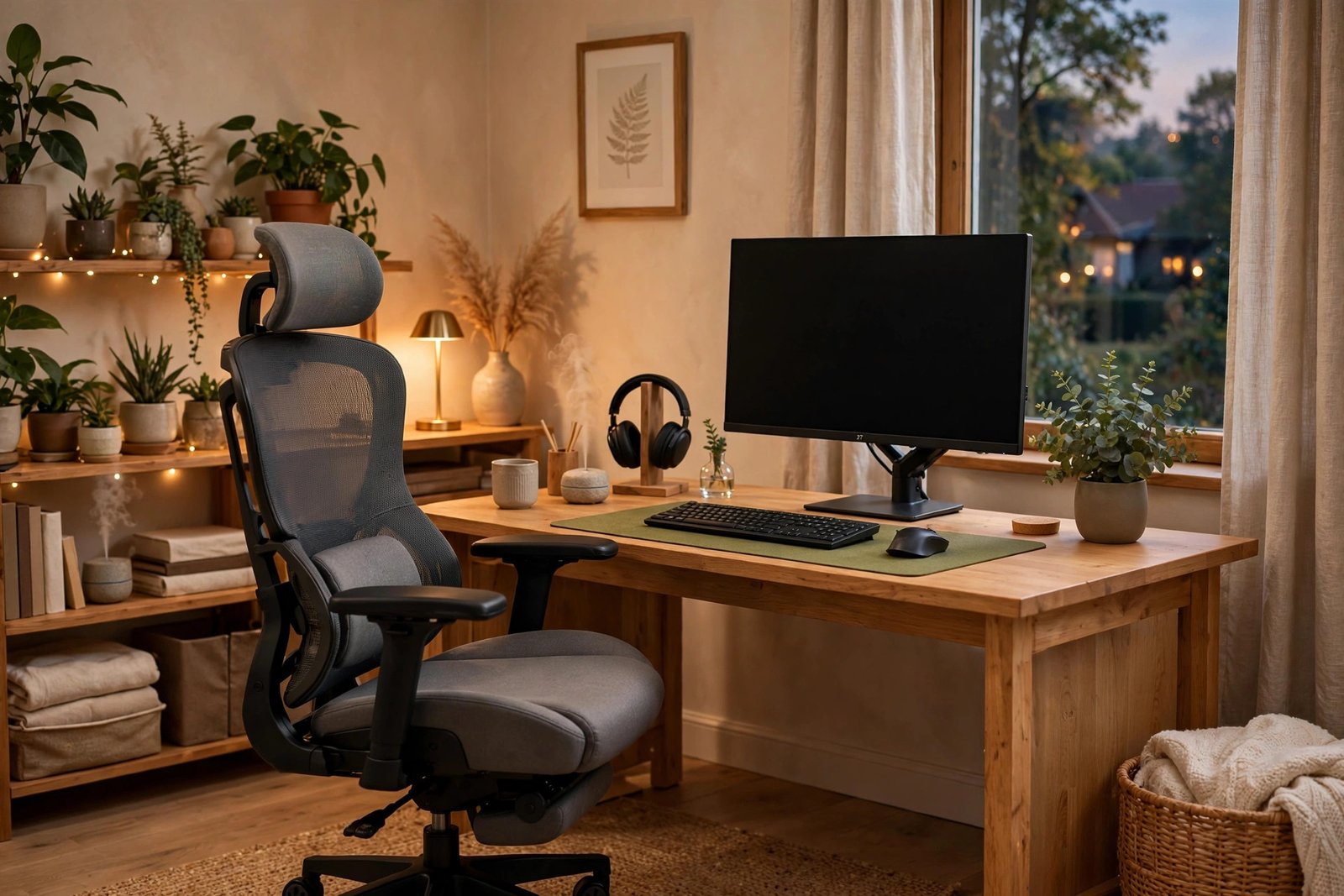
Racing styling promises speed, support and status in a glossy package. Sit for a long session, though, and your back delivers a far more honest review than any product page.
Why do racing shapes feel wrong at a desk?
A bucket shape makes sense in a car that corners hard. Side bolsters hold a driver in place against forces pushing the body sideways, the seat is fixed in a shell, and the drive is short compared with a working or gaming day. None of that describes a desk. At a desk you face no cornering forces to resist. There is only sitting, shifting, reaching for a drink, leaning back to think and leaning in when a game or a document tightens its grip. Bolsters that looked sporty in a photograph then start to boss the sitter around. They press into thighs and shoulders, narrow the usable seat, and discourage the small changes of position that keep a body comfortable over hours. A shape that prevents movement is the opposite of what long sitting needs.
That mismatch shows up in heat as well as pressure. Deep shells wrap around the back and sides, closing off airflow and holding warmth against the body. Across an evening, warmth builds, restlessness follows, and concentration leaks away. The lesson hidden in comparing console and computer gaming for beginners applies here too: equipment that looks thrilling in a picture must still suit the way the activity actually happens, hour after hour, in a real room. Racing chairs are not all dreadful, and a well made one with a flatter seat can serve a smaller sitter happily. The warning is about priority. When the shape is chosen first for how it photographs, fit for the human inside it usually comes second, and the human pays for that order every single session.
Which adjustments matter more than thick padding?
Thick padding photographs well and feels plush for the first minutes in a showroom. It is a poor predictor of comfort by the third hour. Foam that is too soft lets the body sink until posture collapses, while foam that is too firm creates pressure in one spot and never lets it spread. What lasts is adjustability, because adjustability lets a chair meet a particular body rather than an average one invented by a marketing team. Start with height. Your feet should rest flat and steady, with weight shared and no dangling or perching. Move to seat depth. A seat that is too deep presses behind the knees and tempts slouching, while one that is too short leaves the thighs unsupported. The front edge should finish clear of the back of the knees, leaving a small, comfortable gap.
Armrests are the next test, and they fail in two directions. Arms set too low might as well not exist, leaving shoulders to carry the arms all day. Arms set too high, or fixed where they cannot move, lift the shoulders towards the ears and build tension into the neck. Look for arms that adjust in height at least, and ideally in width and fore and aft position too, so elbows can rest lightly while hands reach keyboard, mouse or controller without shrugging. Tilt matters as well. A backrest that can recline slightly, and lock or float at a tension that suits your weight, lets you change the load on the spine instead of holding one angle until it aches. Backrest height, headrest position where one is fitted, and the general width of the chair complete the fit picture. A larger sitter in a narrow chair and a smaller sitter rattling in a vast one will both be uncomfortable, however generous the padding, so match the size range the maker states to your own build honestly, including the stated weight the mechanism is built to carry.
What makes lumbar support genuinely supportive?
The lower back curves inward, and a good chair meets that curve rather than flattening it or shoving it forward. Genuine support therefore has two qualities. It sits in the right place for your back, and its firmness suits you. A loose pillow strapped behind the sitter often fails both tests. It slides when the sitter moves, it pushes one spot hard while ignoring the rest, and its thickness can push the whole body forward so the seat feels shorter. Many owners quietly remove such pillows within weeks, leaving the chair with no lumbar support at all despite the promise on the box. Built in support that can be moved up and down, and ideally adjusted in depth, behaves very differently. It stays where it was set, spreads pressure more evenly and can be eased on a day when the back feels tender or firmed when support is wanted.
The wider discipline behind these details is set out in overviews of ergonomics and designing work around people, which treat fit between body, task and equipment as the thing to design for, not an afterthought. Hold any chair to that standard when you test it. Sit as you normally sit, not in a parade posture you will abandon in ten minutes. Does the support meet the small of the back without forcing an arch? Does it stay there when you recline a little and return? Can you adjust it while seated, or must you stand and wrestle with straps? A chair that only supports you in one rigid position is offering a pose, not support. Real support follows the back through the small range of positions a long session naturally uses, and it never relies on the sitter staying still to make the chair look correct.
How do fabrics and mesh behave across long sessions?
Materials decide how a chair feels in summer, how it ages, and how much care it demands. Breathable fabric lets air move and tends to stay neutral in temperature, which is why it remains a safe choice for warm rooms and long sessions. Mesh goes further on airflow, flexing against the back and letting heat escape, though its feel divides opinion. Some sitters love the suspension and coolness. Others find a firm mesh frame edge or a lack of cushioning less forgiving, especially on the seat. Quality differs widely here. A well tensioned mesh holds its support for years, while a cheap one can sag into a hammock that supports nothing.
Synthetic leather is the material to question hardest. It looks smart, wipes clean and photographs like luxury, which explains its popularity on gaming chairs. Over time and heavy use, bonded forms of it are prone to cracking and peeling, especially where arms, legs and belt buckles rub and where warmth and sweat gather. Once the surface breaks, no cream restores it, and the chair looks tired long before its frame fails. A smoother, higher grade covering lasts better, but it still traps more heat than fabric or mesh. Think about your room as honestly as your body. A warm room and a long evening argue for breathability. Fabric may need prompt attention to spills, while a wipeable surface suits a desk where drinks live close. The failure is choosing by photograph alone, without asking how the surface will feel after years of daily contact.
When does an office chair beat a gaming label?
An office chair wins whenever the work is sitting well for a long time, which for most players is most of the time. Makers of serious office seating compete for employers who buy in bulk and complain in bulk when backs ache and mechanisms break, so their designs are judged on adjustability, durability and support across a working day. That history is traced in accounts of office chair design and seated posture, showing how adjustable seating developed around people who sit for a living rather than around a sport the sitter is not playing. The practical result is chairs with better tilt mechanisms, more thoughtful lumbar systems, stronger bases and a quieter look that blends into a shared room or home office without announcing a hobby to every visitor and video call.
Refurbished premium office chairs deserve a special mention in this comparison, stated in purely practical terms. A chair built for heavy office use, professionally cleaned and checked, can offer adjustments and build quality that a style led new gaming chair at a similar level simply does not attempt. Check what has been replaced or tested, especially the gas lift that controls height and the tilt mechanism, since those moving parts carry the wear. The gas lift that sinks slowly during a session and the tilt that creaks, sticks or will not hold its angle are the failures that most often end a chair’s useful life, whatever its label. A meaningful warranty on those parts says more than a slogan about comfort, because it shows the maker expects the mechanism to survive real use. If your sessions mix work and play in the same chair, the office route usually serves both lives better. If a gaming chair genuinely fits you, adjusts fully and uses honest materials, buy it for those reasons, not for the wings on its shoulders.
Why does a home trial reveal more than showrooms?
A showroom sit lasts minutes, in the wrong clothes, at the wrong desk, under bright lights, with a salesperson nearby. It can reveal wobbles, damage and obvious size mistakes, and little else. Comfort is a slow verdict. Pressure points declare themselves after a long session, heat builds gradually, and only your own desk reveals whether the armrests clash with its edge, whether the chair rolls well on your floor, and whether the backrest suits the way you actually lean when concentrating. A home trial, where returns terms honestly allow one, lets the chair face real evenings, real work and a real bad back day. Read those terms before ordering rather than after disappointment, and keep packaging until the verdict is in, since returns conditions often depend on it.
Even the right chair needs help from habit. No seat makes unbroken sitting comfortable. Stand, walk and stretch between matches or tasks, and shift position often. During the trial, test methodically. Spend one session with the lumbar support firmer and another softer. Try the tilt locked and floating. Notice your shoulders at the end of the evening, not just your back, and whether you fidget more or less than in the old chair. Fit first, materials second, label last: a chair bought in that order rarely needs replacing in a hurry.