A home quiz night lives or dies in the preparation, long before the first question is read aloud to the room. Balanced rounds, checked answers and a brisk host turn a living room into a proper contest.
How many rounds keep an evening lively?
Fewer than enthusiasm suggests, and more varied than habit allows. A lively evening needs enough rounds to give every team a fresh start several times over, yet few enough that nobody glances at the clock during the final stretch. Think in terms of rhythm rather than arithmetic. Open with a general round that settles nerves and lets the host find a pace, follow with themed rounds that play to different strengths around the room, and save something playful for after the food break, when energy dips and silliness rises. Short rounds beat marathon ones. Attention stays bright when a round ends while people still want more, and the host who trims generously in advance never has to apologise mid-evening.
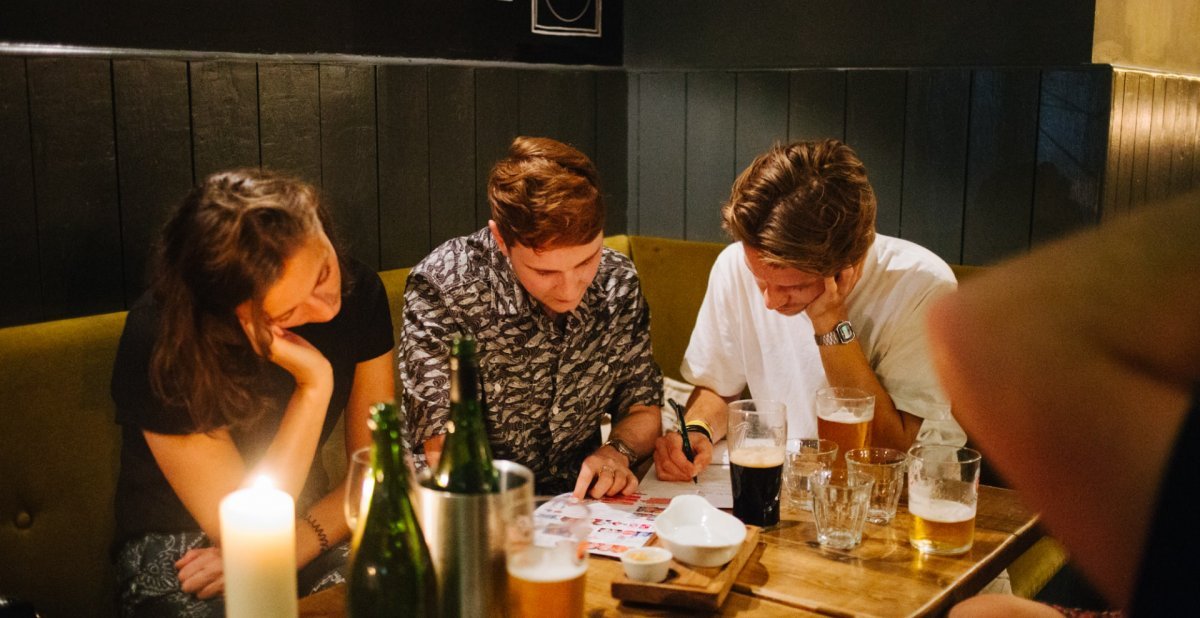
Wikipedia’s pub quiz article describes a quiz held in a pub or bar that attracts customers on quieter evenings, typically played in teams answering questions read by a quizmaster across themed rounds, and that pub rhythm translates beautifully to a front room. Build in pauses between rounds for drinks, marking and argument, because the social spaces around the questions are where half the fun lives. Finish on a round everyone can join, perhaps music or local knowledge, so the night ends in shared noise rather than specialist triumph. If in doubt, prepare one round more than you expect to use and hold it in reserve. Dropping a round is painless. Inventing one at midnight is not. Readers keen on getting better at pub quizzes yourself will recognise the same principle from the player’s side: variety is what keeps a quiz feeling fair and alive.
What makes a round fair for every team?
Fairness is a design problem, solved at the writing desk. A fair round mixes questions most teams can answer with a couple that stretch everyone, so that scores spread out gradually instead of splitting the room into geniuses and spectators by the third question. Balance the subjects ruthlessly. A round of sport questions delights one corner and silences another, whereas a blend of history, food, geography, film and everyday life gives every team member a moment to be the hero. Check each question for accidental traps: ambiguous wording, answers that changed recently, and facts with two defensible versions.
Above all, verify every answer as you write it, from a reliable source, and note that source beside the question. Nothing corrodes a host’s authority faster than an official answer the room can prove wrong, and nothing protects it like cheerfully producing the evidence. Wikipedia’s trivia article explains that trivia concerns comparatively inconsequential pieces of information, the raw material from which general knowledge rounds are usually built, which is a useful reminder that obscurity is not quality. The best questions feel obvious the moment the answer is revealed, prompting groans of recognition rather than blank stares. Fairness also means pacing difficulty across the whole evening, so no team spends an hour feeling hopeless. A team in last place that keeps landing the odd triumph will stay cheerful, competitive and eager to return next time. The pub quiz traditions, teams and quizmasters that Wikipedia describes survived decades of weekly play because their scoring stayed transparent enough for a crowded bar to follow.
Which interactive rounds lift an ordinary quiz?
Paper questions carry an evening only so far. The rounds guests describe afterwards are usually the ones that got them moving, listening, tasting or shouting across the room. Music is the classic lifter: play the opening moments of well-known songs and ask for title and performer, with extra credit for the year of release left out entirely, since nobody sensible wants a dispute about dates. Intros should span decades so that every generation hears something it owns. Picture rounds travel well too. Print or display a sheet of faces, landmarks, book covers or household objects photographed from odd angles, and let it circulate during other rounds so teams can chip away at it whenever inspiration strikes.
Tasting rounds create legends. Small cups of crisps, chutneys, cheeses or cordials, identified blind, produce more laughter per minute than any other format, provided allergies and dietary needs are checked in advance and respected without fuss. Keep interactive rounds simple to explain and quick to mark, and alternate them with straight question rounds so the evening breathes. Wikipedia’s quiz entry reminds us that quizzes as competitive question games explained rest on players attempting to answer correctly, often competitively, and the interactive formats honour that core while wrapping it in theatre. One well-judged novelty round per half is plenty. Novelty everywhere becomes chaos, and chaos marks badly.
How should a host handle phones and disputes?
Agree the rules before the first question, while everyone is still smiling. The phone agreement works best framed as a shared promise rather than a police action: phones stay in pockets or face down in the middle of the table during rounds, because a quiz in which answers can be summoned instantly is not a quiz at all. Say it warmly, say it once, and let the room’s own sense of fair play do the enforcing. Most guests police themselves happily once the norm is named.
Disputes need a constitution too. Announce in advance that the host’s ruling is final, that near answers earn what the host judges fair, and that spelling never matters unless meaning changes. When a challenge comes, hear it out briefly, check your noted source, and rule with a smile and no lingering. If the room proves your official answer wrong, concede instantly and award the point to every team that had it right. A host who can lose an argument gracefully gains more authority than one who never admits error, and the evening’s mood matters more than any single mark. Keep a small stock of bonus questions ready to settle honour in a drawn-out quarrel. Above all, protect the tone. A quiz night is a party wearing a contest’s clothing, and the host’s real job is to keep both halves alive, firm on fairness and light about everything else.
What scoring system keeps tension without arguments?
Simple, visible and frequent. Those three qualities matter more than any clever weighting scheme. A point per answer, totals read aloud after every round, and a running scoreboard everyone can see will carry almost any evening. Mark as you go if the room is small, reading answers immediately so queries surface while the question is fresh. In a larger gathering, have teams swap sheets and mark one another’s, which spreads trust and gives the host a breather.
Handle jokers and bonuses with care. A played joker that doubles one chosen round adds strategy and gives trailing teams a story to chase, but explain it once, clearly, before play begins, and never allow it to be moved once declared. Bonus points for the picture sheet, tallied late in the evening, keep a second race running beneath the main one. Avoid fractional marks, complicated handicaps and sudden-death tiebreakers involving obscure facts. Break a tie instead with something theatrical and quick, such as the nearest guess to a measurable household fact, which resolves the night in laughter rather than grievance. Keep it transparent and the tension takes care of itself, rising gently all evening without once needing to be rescued from an argument about arithmetic.
Which prizes reward winners and losers kindly?
Prizes should be modest, funny and slightly coveted, in that order. Grand rewards poison a friendly contest, inviting the sort of seriousness that makes people check answers under the table, whereas small, well-chosen tokens give the evening a finish line worth sprinting for. Food and drink prizes disappear happily and photograph well: a fine bar of chocolate, a jar of something local, a bottle chosen with a wink at the winners’ known tastes. Joke prizes with a story attached often outshine them. A trophy of magnificent cheapness, engraved by hand and returned each time to be defended, can become the most contested object in a group’s social calendar.
Never let last place leave empty-handed. A wooden spoon, presented with ceremony and genuine applause, regularly becomes the award teams secretly covet, precisely because it carries no shame, only affectionate fame. Small consolation sweets for every team soften the table further and cost the host little. Wrap prizes simply, present them slowly, and let the room applaud each one, because the ceremony is the prize as much as the object. Avoid prizes that single anyone out unkindly, rewards tied to drinking, or anything that obliges the winner to host next time unless that honour is genuinely desired. Kind prizes close the competition the way a good host should, leaving winners pleased, losers plotting cheerfully, and everyone faintly hoping the spoon, next time, might be theirs.
How does feeding guests change the whole evening?
Food is not decoration at a quiz night. It is fuel, pacing and hospitality in one, and a hungry room quizzes measurably worse than a fed one, growing tetchy over disputes that a full stomach would have laughed off. Build the evening around a break in the middle, long enough for a proper graze and short enough that the contest’s thread survives. Grazing dishes suit the format best: things that can be eaten between rounds without cutlery gymnastics, that hold their quality at room temperature, and that guests can revisit whenever concentration needs restoring. A generous cheese board, good bread, roasted nuts, crudités with dips, sausage rolls and something sweet near the end will carry most rooms handsomely.
Drinks deserve the same forethought. Keep water visible and plentiful, offer something interesting without alcohol alongside the usual choices, and place everything where guests can serve themselves without crossing the host’s working space. Dietary needs should be gathered when invitations go out, quietly and without fuss, so that nobody at the table faces a spread they cannot touch. Timing is the subtle art. Serve the heartiest food in the break rather than during a round, keep bowls topped up discreetly between rounds, and hold dessert back as a reward that arrives with the final scores. A fed room is a generous room, quicker to forgive a hard question and slower to quarrel with a ruling. Feed people well and the quiz stops feeling like an examination held in a front room. It becomes what it was always meant to be: supper with friends, sharpened by friendly rivalry.