
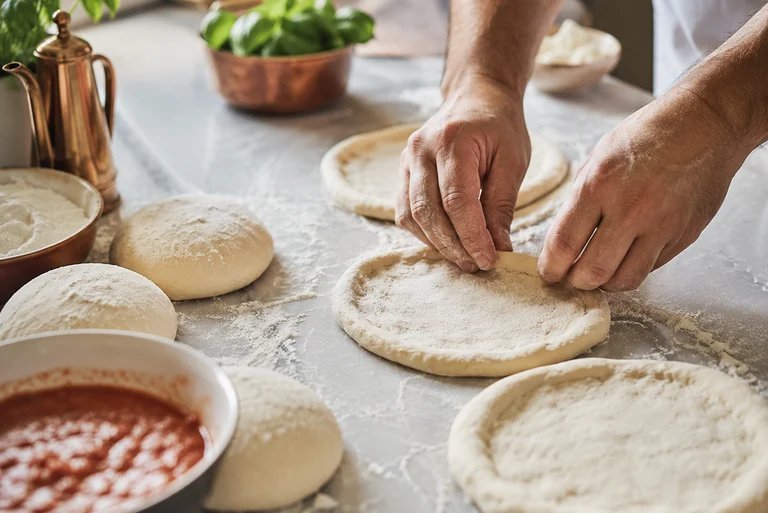
Great pizza starts with great dough — and great dough needs nothing more than your hands. When people ask how can I make pizza dough without a stand mixer, they’re usually surprised to learn that hand-made dough is not the compromise option: many pizzaiolos insist hand-kneading gives better feel and control than machines.
I’ve made pizza dough weekly for years — by hand, because I’ve never owned a stand mixer — and the method below produces blistered, chewy, leopard-spotted crusts from a domestic oven. Here’s the recipe, the kneading technique, and the no-knead alternative for the truly lazy.
How can I make pizza dough without a stand mixer? The hand method
The recipe (makes 4 pizzas): 600g strong white bread flour (‘00’ flour if you can get it — finer, silkier crumb), 400ml lukewarm water, 10g fine sea salt, 7g instant dried yeast (one sachet), 1 tbsp olive oil, 1 tsp honey or sugar. Mix the flour and water roughly, rest 20 minutes (the autolyse — lets the flour hydrate, making kneading dramatically easier), then add salt, yeast, oil and honey and mix to a shaggy dough. Tip onto an unfloured surface — yes, unfloured; the stickiness is your friend for hand-kneading.
The kneading technique: the slap and fold. Lift the dough, slap it down, stretch it forward, fold it back — rhythmic, almost violent, and weirdly fun. Ten minutes of this transforms the shaggy mess into a smooth, elastic ball that passes the windowpane test (stretch a piece thin — it should stretch translucent without tearing). If it sticks to your hands, wet them, don’t flour the surface — added flour throws off the hydration. Then bulk ferment: into an oiled bowl, cover, 1–2 hours at room temperature until doubled, then divide into 4 balls (about 250g each), and cold-proof in the fridge overnight — the cold ferment develops the flavour that separates good pizza from great.
The no-knead overnight alternative
For the ultimate lazy method: mix 500g flour, 350ml water, 10g salt and just 2g yeast (a scant half-teaspoon) into a shaggy dough — no kneading at all — cover, and leave at room temperature for 12–18 hours. Time does the kneading: the long, slow ferment develops gluten and deep, complex flavour that the quick method can’t match. In the morning, divide into balls, rest 2 hours, and shape. This is the method for planners — mix tonight, pizza tomorrow — and it produces a more flavourful crust than the quick version with literally 5 minutes of effort.
Whichever method, the shaping is the same and it’s the step people fear most. On a floured surface, press the dough ball flat from the centre outward, leaving a puffy 1cm rim (the cornicione — the coveted puffy edge). Never use a rolling pin — it crushes the air bubbles you’ve spent hours building. Pick it up and let gravity stretch it, rotating through your knuckles, until it’s 10–12 inches. Patch any thin spots by folding dough over them. Imperfectly round is authentic — Naples approves.
Baking: the home-oven maximum
Your oven is the limitation — pizzerias hit 450°C+, yours manages 250–270°C — so maximise what you have. Preheat at absolute maximum for a full hour with a pizza stone or steel inside (a £30 pizza steel outperforms a stone: it transfers heat faster for better bottom char). Launch the topped pizza onto the steel with a floured peel or the back of a baking sheet, bake 6–8 minutes until leopard-spotted and puffy. Less is more on toppings — a wet, overloaded pizza steams instead of crisping.
Sauce simply: tinned San Marzano-style tomatoes crushed with salt — uncooked, never simmered (it cooks on the pizza). Cheese: low-moisture mozzarella, torn and drained, not the watery fresh stuff (save fior di latte for eating fresh). Finish with olive oil, basil and flaky salt after baking, not before. And the two-pizza rule: make dough for more than you need — balls keep 3 days in the fridge and freeze brilliantly. Friday pizza night becomes a 20-minute assembly job, and homemade beats delivered on every axis except washing up.
Troubleshooting dough problems
Dough too sticky to handle? It’s probably fine — pizza dough is meant to be tacky. Wet your hands instead of adding flour (extra flour throws off the hydration and makes dense crusts). If it’s genuinely soupy, the flour may be low-protein — next time use strong bread flour; this time, give it a few more slap-and-fold sessions, which develop the gluten that brings it together. Dough not rising? The yeast is the suspect — check the date, proof it in warm water with a pinch of sugar (it should foam in 10 minutes), and ensure the water wasn’t hot (over 45°C kills yeast). Cold kitchen? The fridge-cold ferment works regardless; room-temperature rises just take longer.
Tough, dense crust? Under-fermented (give it more time — the poke test: a floured finger dent should spring back slowly, not instantly and not stay), over-floured during shaping, or baked too cool (maximum oven heat, full hour preheat — non-negotiable). Soggy centre? Too many wet toppings, sauce too thick, or the pizza sat on the peel too long before launching (assemble fast, launch immediately). The troubleshooting mindset: dough is alive and variable — flour, temperature and humidity all shift — so learn to read it (smooth? elastic? airy? doubling?) rather than watching the clock. The clock is a guide; the dough is the truth.
- Too sticky? Wet hands, not more flour
- Not rising? Test the yeast; check water wasn’t too hot
- Dense crust? Under-fermented or oven not hot enough
- Soggy centre? Fewer wet toppings; launch immediately
- Read the dough, not the clock — poke test for readiness
Hand-made pizza, pizzeria results
Strong flour, proper hydration, slap-and-fold kneading (or the no-knead overnight), cold ferment for flavour, hand-shaped never rolled, baked at maximum on a steel. Your hands are the only mixer you need — and they’ve been making bread for ten thousand years.
For more from-scratch confidence, easiest baking recipes for beginners is the beginner baking guide and bake a cake that does not sink in the middle fixes cakes that sink. For topping inspiration, BBC Good Food’s recipe collection has brilliant pizza recipes.
The dough-master’s confidence: every problem has a cause, every cause has a fix, and the fixes are all simple once you understand the dough is alive. Flour, water, salt, yeast, time — five ingredients, ten thousand years of practice. Your hands know what to do; let them learn.


