How often should I water? It is the most asked question in gardening — and the most common cause of plant death is getting the answer wrong. Overwatering drowns roots; underwatering stresses everything. Beginners either water on a rigid schedule regardless of weather or water randomly when guilt strikes. Both fail.
So is now the right time to learn watering properly, or can it wait? Now — unequivocally. Watering skill is the highest-leverage knowledge in gardening: it affects every plant you own, the learning applies immediately, and the cost of ignorance is dead plants. Here is the complete beginner’s guide to understanding watering schedules.
Why Schedules (Alone) Do Not Work
The fundamental truth: plants need water when the soil dries, not when the calendar says so. A “water every Tuesday” schedule drowns plants in a wet June and desiccates them in a heatwave August. Soil type, weather, plant type, growth stage, pot versus ground, mulch cover — all change water needs constantly. Rigid schedules ignore every variable that matters.
What works instead: observation-based watering — a simple routine of checking on a schedule, then watering based on what you find. The schedule is for looking, not for watering. This distinction is the entire art: disciplined observation, responsive action. It takes two minutes per check and prevents nearly all watering mistakes.
The Finger Test: Your Primary Instrument
Forget moisture meters (unreliable) and apps (approximate). The tool professionals use: your finger. Push it 3–5cm into the soil. Moist? Do not water. Dry at that depth? Water. This single test, applied consistently, outperforms every gadget — because it measures the actual root zone, not the surface (which dries misleadingly fast) or a probe’s guess.
Learn your soil’s rhythm: after watering thoroughly, check daily — note how many days until the finger test says dry. That interval, for that bed, in that weather, is your real schedule. It lengthens in cool cloudy weeks, shortens in heatwaves, and varies between beds. Within a month you will know each area’s rhythm intuitively. The RHS watering guidance details the principles for different plant types.
How to Water Well (Technique Matters)
Water the soil, not the leaves: wet foliage invites fungal disease; roots drink from soil. Water deeply and less often: a thorough soaking that penetrates 15–20cm encourages deep roots; daily sprinkles create shallow, drought-vulnerable root systems. Water in the morning: foliage dries by evening (disease prevention), and plants face the day’s heat fully hydrated. Evening is the second choice; midday wastes water to evaporation. Mulch everything: a 5–8cm mulch layer halves water needs by shading soil and retaining moisture — the single highest-ROI watering action. New plantings need more: recently planted specimens need consistent moisture for their first season while roots establish; established plants are far more forgiving.
Containers are the special case: pots dry dramatically faster than ground soil — daily checking in summer is mandatory, twice-daily in heatwaves. Self-watering pots and saucers help, but there is no substitute for the finger test. If you garden mainly in containers, watering skill matters doubly.
Seasonal Rhythms (The UK Calendar)
Spring: increasing need as growth accelerates; watch new plantings and containers closely. Summer: peak demand — established borders may need weekly deep watering in dry spells; containers daily; vegetables (especially tomatoes and courgettes) are thirstiest. Autumn: taper off as growth slows and rain returns; overwatering dormant plants causes rot. Winter: minimal — most plants dormant; water only containers in dry spells and anything under cover (rain does not reach them).
The hosepipe-ban question arises most summers now: check your water company’s current status, water early morning for efficiency, prioritise new plantings and vegetables over established ornamentals (which mostly survive drought), and consider a water butt (£30–£60) — free rainwater, always available, and plants prefer it. The Met Office forecasts are the gardener’s planning tool — check the week’s rain before deciding whether to water.
Watering Systems: From Can to Automation
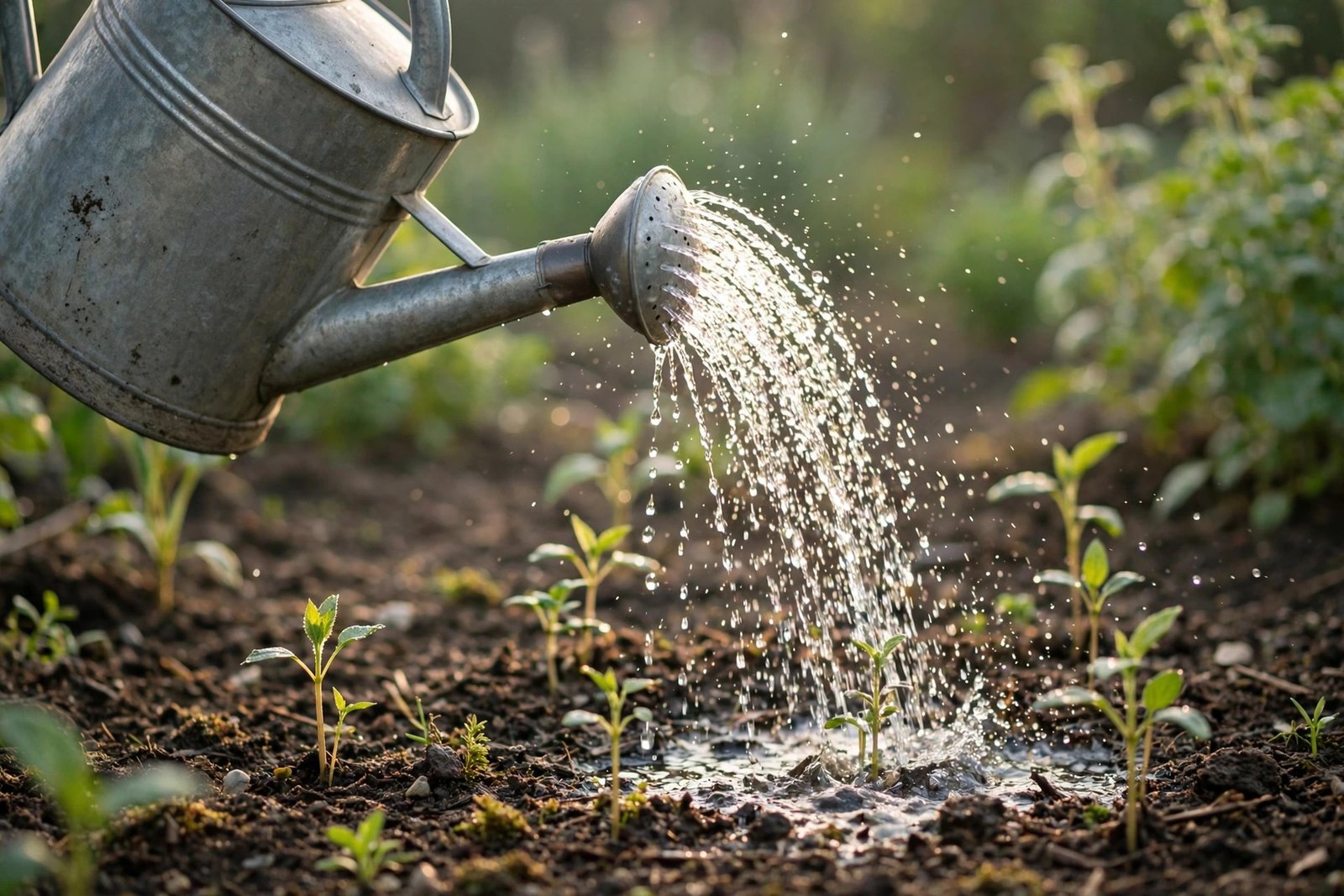
Technique matters, but so does infrastructure — and the options scale with commitment. The watering can (£5–£15): the beginner’s tool and the precision instrument — perfect for containers, seedlings, and targeted watering. Slow for large areas, unbeatable for control. Every gardener should own two. The hosepipe (£15–£40): the workhorse for borders and lawns — pair with a rose attachment for gentle watering and a trigger gun to avoid waste. Seep hoses and drip irrigation (£20–£60): porous hoses that weep water directly into soil — the efficiency champions, delivering water to roots with minimal evaporation. Laid under mulch, they are nearly invisible and enormously effective for vegetable beds and borders.
Water butts (£30–£60): not a watering system but a supply — 200 litres of free rainwater per butt, and plants genuinely prefer rainwater (softer, chemical-free) to tap water. Connect to a downpipe with a diverter kit; one butt waters a small garden for weeks. Timers (£15–£35): battery-powered tap timers automate hosepipes and drip systems — set for early morning, go on holiday without plant anxiety. Full automation (£100–£300+): zoned drip systems on timers with rain sensors — the serious setup for large gardens or frequent travellers.
The budget wisdom: start with cans, add a butt, graduate to seep hoses under mulch for thirsty areas. Automation is wonderful but optional — the finger test and a can, applied consistently, outperform neglected automation every time.
Why Now Is the Time to Learn
The “wait” case collapses on inspection. Watering knowledge has no expiry — the principles are timeless. Every week of unskilled watering risks plants you have already paid for. And the learning is active: you can only learn watering by watering, observing, and adjusting — which means starting now. A month of finger-test discipline teaches more than any article (including this one). The skill compounds across every plant you will ever grow, in every garden you will ever have.
It also connects to everything else: mulching (water retention), soil improvement (water holding), plant choice (right plant, right moisture), and low-maintenance gardening — which is largely water-wise gardening by design. And a well-watered garden simply looks better — the foundation of making your garden look nice on a budget.
The Bottom Line
Understanding watering schedules means: check on a schedule, water on observation (the finger test at 3–5cm), water soil not leaves, deeply and in the morning, mulch everything, and learn each bed’s rhythm. Start now — the skill is timeless, the learning is active, and every plant you own benefits immediately. It is the closest thing gardening has to a master key.
Frequently Asked Questions
How often should I water my garden?
When the soil is dry 3–5cm down (the finger test) — not on a fixed schedule. This varies by weather, soil, and plant type; check regularly and water based on what you find.
Is it better to water in the morning or evening?
Morning is best: foliage dries by evening (preventing disease) and plants face the day hydrated. Evening is second choice; avoid midday (evaporation waste).
How do I know if I am overwatering?
Yellowing leaves, wilting despite wet soil, mouldy soil surface, and root rot. When in doubt, check with your finger — most beginners overwater, not underwater.
Do I need to water in winter?
Rarely — most plants are dormant. Water containers in dry spells and anything under cover (greenhouses, porches) that rain cannot reach.