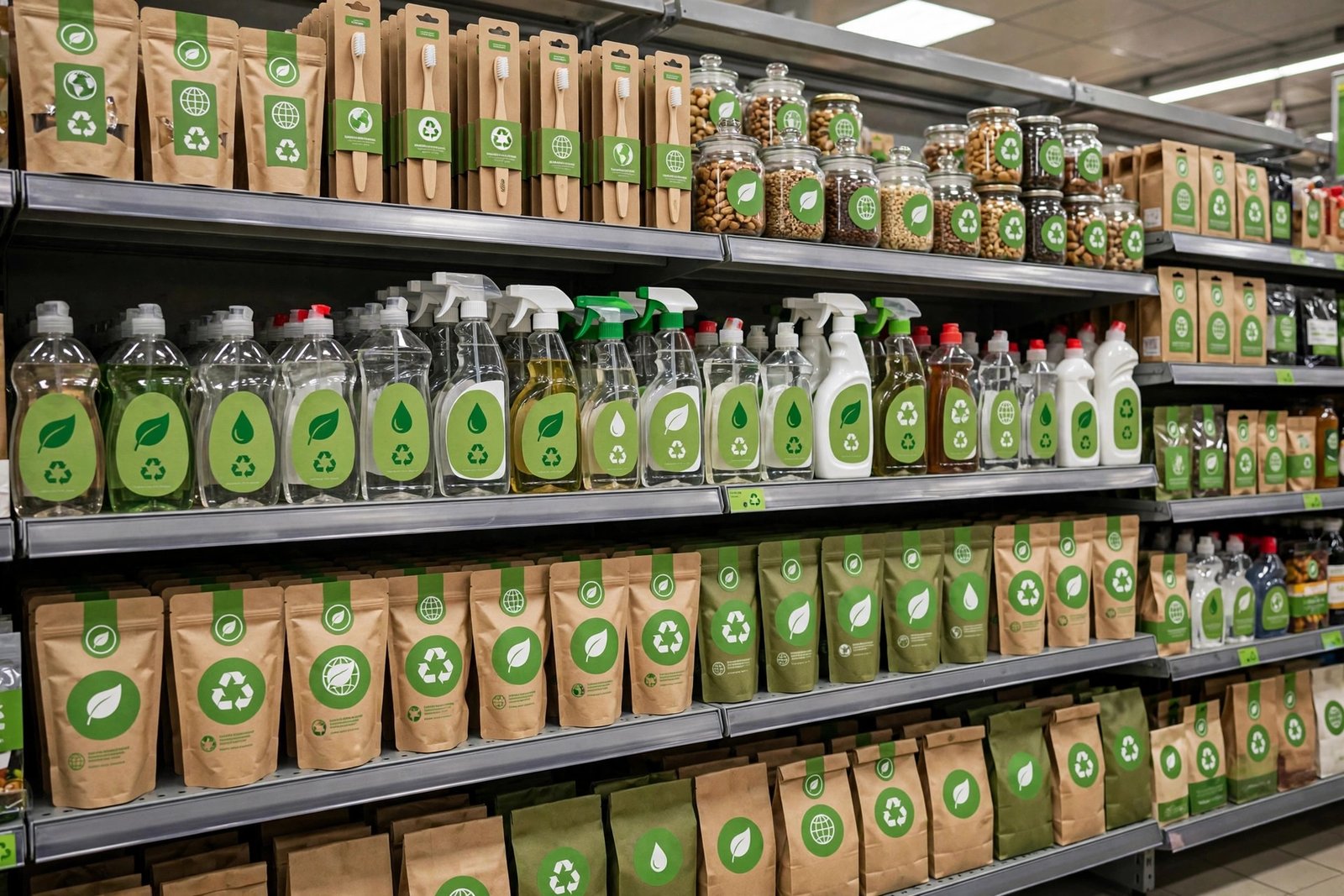
“Eco-friendly.” “Carbon neutral.” “Sustainably sourced.” “Green.” Walk down any supermarket aisle or scroll any fashion site and these words bloom like algae — and about as nourishing. Greenwashing — making products, companies or policies seem more environmentally friendly than they are — has become so pervasive that the UK’s Competition and Markets Authority had to step in with a Green Claims Code, and the EU is moving to ban vague environmental claims outright. But is understanding greenwashing actually worth your time as a beginner? The answer is a strong yes, for a reason that goes beyond virtue: greenwashing costs you money, directing your spending toward products that charge a premium for greenery that isn’t real.
What Greenwashing Actually Looks Like
The classic taxonomy (from TerraChoice’s “Seven Sins,” still the clearest framework):
- The sin of vagueness: “eco-friendly,” “natural,” “green” — words with no definition, no standard, no proof. If a claim cannot be measured, it cannot be true.
- The sin of no proof: “sustainably sourced!” — says who? Certified by whom? Genuine claims name the certifier.
- The sin of irrelevance: “CFC-free!” — CFCs have been banned for decades. True, and meaningless.
- The hidden trade-off: “recycled packaging!” on a product whose manufacture is enormously polluting — one green attribute distracting from the overall footprint.
- Lesser-of-two-evils: “eco cigarettes,” “green” SUVs — a marginally less bad version of an inherently harmful product, marketed as a solution.
- Fibbing: outright false claims — rarer now, thanks to regulators, but it happens.
- Worshipping false labels: invented eco-badges designed to look like certifications — the green leaf logo the company drew itself.
Modern additions: greenhushing (companies hiding genuine green progress for fear of scrutiny — the opposite problem), offset-dependent “carbon neutral” claims (neutrality via cheap offsets rather than actual cuts), and the tiny-green-line fallacy — the “conscious collection” representing 3% of a fast-fashion giant’s output.
The Money Case: Why It’s Worth Your Time
Greenwashed products routinely command 10–30% price premiums — the “eco” laundry detergent, the “sustainable” fashion line, the “carbon-neutral” delivery option. If the greenery is real, the premium may be justified (genuinely sustainable production often costs more). If it is wash, you are paying extra for a story. Learning to distinguish the two — a skill acquirable in an evening — directly protects your wallet on every future purchase.
There is a second, subtler cost: moral licensing. Buying the “eco” option can make people feel they have done their environmental bit, reducing pressure for the higher-impact changes (flying less, eating less meat, insulating the home). Greenwash does not just waste money; it absorbs the motivation that real change needs. Understanding it is therefore protective twice over.
The 5-Minute Greenwash Detector
You do not need a sustainability degree. Run every green claim through these five questions:
- Is it specific? “Made with 80% recycled aluminium, certified by…” beats “eco-friendly packaging.” Vague = wash until proven otherwise.
- Is it certified by a third party? Trustworthy marks: FSC (sustainable forestry), MSC (sustainable seafood), Fairtrade, GOTS (organic textiles), Soil Association Organic, Energy Saving Trust Recommended, EU Ecolabel. Self-awarded badges and invented leaves: ignore.
- Is it the whole product or one attribute? “Recyclable bottle” for a single-use plastic bottle is a hidden trade-off — the product is still single-use. Judge the product, not the attribute.
- Does the company’s core business contradict the claim? The oil major’s algae biofuel advert, the fast-fashion “conscious” line, the airline’s “sustainable aviation” while expanding routes — the claim may be technically true and strategically meaningless.
- Can I verify it in 60 seconds? Genuine claims survive a search: the certification database, the company’s sustainability report with actual numbers, the regulator’s register. Wash evaporates under the same scrutiny.
Five questions, one minute each, applicable to everything from updating your wardrobe without fast fashion to choosing cleaning products. The parallel skill — telling whether a website is safe to buy from — uses the same verification muscle for a different kind of deception.
What the Regulators Are Doing (Your Backstop)
You are not alone in this fight. The CMA’s Green Claims Code (2021) sets six principles — claims must be truthful, clear, substantiated, consider the full lifecycle, and be comparable — and the CMA has investigated fashion, groceries and household goods sectors, securing undertakings from major retailers. The Advertising Standards Authority bans misleading green ads (and its rulings are public and searchable — a free education in wash-spotting). The EU’s Empowering Consumers Directive will ban generic claims like “eco-friendly” without recognised proof. The direction is clear: the burden is shifting from consumers detecting wash to companies proving green. Your detector is the bridge until the regulation fully arrives.
Beyond Spotting: Spending That Actually Matters
The detector is defensive; the offence is directing money to the genuinely better: certified products where certification is meaningful, secondhand first (no green claims needed — reuse is inherently low-impact), local and repairable goods, and — the highest-impact move — buying less overall. The most sustainable purchase is the one not made, which no green label can improve on. And for systemic impact, the detector scales: the same scepticism applied to corporate net-zero pledges (are they cutting emissions or buying offsets? is the target date 2030 or 2050? does it cover Scope 3?) separates climate leadership from climate PR.
Conclusion: The Verdict
Is understanding greenwashing worth it for a beginner? Yes — it is one of the highest-ROI hours in conscious consumerism. An evening learning the seven sins and the five-question detector permanently upgrades every purchase decision, protects you from 10–30% wash premiums, and prevents moral licensing from absorbing your environmental motivation. The regulators are catching up, but until vague claims are fully policed, your own detector is the frontline. Learn the certifications that matter, distrust adjectives without evidence, and remember the golden rule: if the greenery cannot be measured, it cannot be trusted — and if it can be measured, someone should be showing you the numbers.
Frequently Asked Questions
What is the most common type of greenwashing?
Vagueness — undefined terms like “eco,” “natural,” “green” and “sustainable” with no standard behind them. It is the cheapest wash to produce and the hardest to challenge, which is exactly why regulators are moving to require substantiation for such terms.
Are carbon-neutral claims trustworthy?
Sometimes, rarely simply. Credible neutrality means: measured footprint, aggressive reduction first, high-quality offsets (Gold Standard or Verra-certified, additional and verifiable) for the remainder, and transparent reporting. “Carbon neutral via offsets” with no reduction plan is the classic lesser-effort wash. Always ask what was cut before what was offset.
Which eco-labels can I actually trust?
The robust third-party certifications: FSC, MSC, Fairtrade, Soil Association Organic, GOTS, EU Ecolabel, Energy Saving Trust Recommended. Treat retailer-created labels and unfamiliar leaf logos with scepticism until verified — the Global Ecolabelling Network lists legitimate schemes.
Can I report greenwashing?
Yes — to the Advertising Standards Authority (asa.org.uk) for misleading ads, and the CMA for systemic misleading claims. ASA rulings are public and searchable, making the complaints database a free masterclass in spotting wash. Enough complaints trigger investigations with real teeth.
Does individual scepticism actually change companies?
Yes — the mechanism is documented. Consumer scepticism plus regulatory pressure has forced major retailers to drop vague claims and sign CMA undertakings. Markets respond to informed demand; every shopper running the five-question detector is a small market signal, and signals aggregate. The CMA’s green claims work shows the regulatory complement in action.