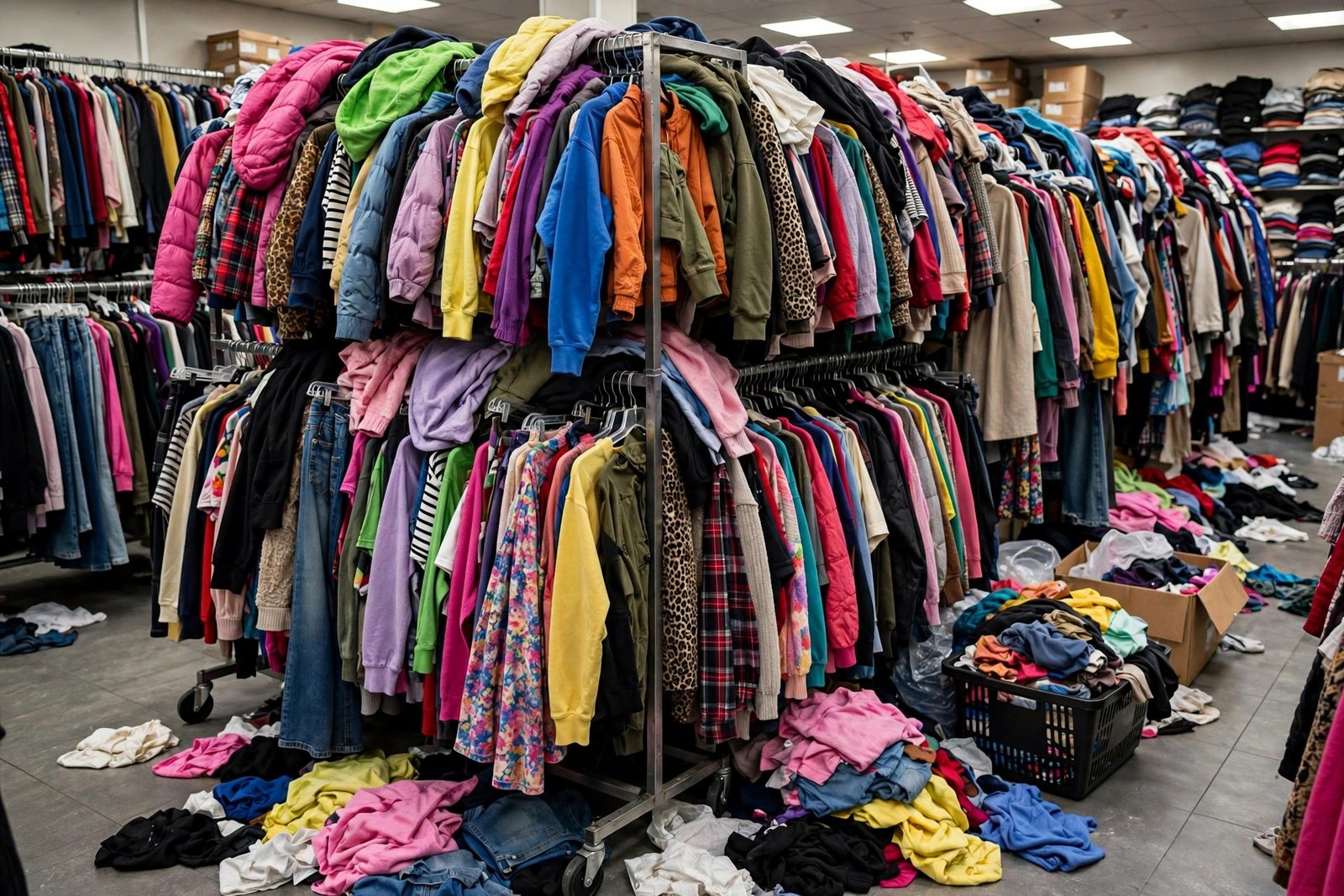
Every year the average Briton buys around 26kg of new clothing — and sends a shocking proportion of it to landfill or incineration within a year or two. The fashion industry produces roughly 10% of global carbon emissions and is the second-largest consumer of water worldwide, yet most of us engage with these statistics the way we engage with airline safety briefings: acknowledged, then ignored. The question “is now a good time to start understanding fast fashion’s impact, or should I wait?” has a particular edge, because the industry is evolving fast — new regulations, resale booms, greenwashing crackdowns — and understanding it now means making better-dressed decisions (literally) while it still matters. The answer: now, and here is the full picture.
What “Fast Fashion” Actually Means
Fast fashion is not just “cheap clothes.” It is a business model: ultra-rapid design-to-shelf cycles (Shein reportedly lists thousands of new items daily), rock-bottom prices engineered through outsourced labour and synthetic fabrics, and marketing built on haul culture and micro-trends with lifespans measured in weeks. The model depends on volume — selling enormous quantities at tiny margins — which is why its environmental logic runs opposite to sustainability: profitability requires overproduction and overconsumption.
The traditional fashion calendar had two seasons; fast fashion has 52 “micro-seasons.” Ultra-fast fashion has effectively infinite seasons. Each acceleration shortens garment lifespans and increases throughput — more clothes made, worn fewer times, discarded faster. The UK now bins around 350,000 tonnes of clothing a year, worth roughly £140 million, much of it barely worn.
The Impact, By the Numbers
- Carbon: fashion accounts for ~10% of global greenhouse-gas emissions — more than international flights and maritime shipping combined (UNEP). A single cotton shirt’s footprint spans farming, spinning, dyeing, shipping and washing.
- Water: producing one cotton T-shirt uses ~2,700 litres of water — what one person drinks in 2.5 years (WWF). Dyeing and finishing pollute rivers in manufacturing regions; the Aral Sea’s desiccation is cotton’s most infamous legacy.
- Microplastics: ~60% of clothing is now synthetic (polyester, nylon, acrylic). Every wash sheds microfibres — an estimated 500,000 tonnes a year reach the oceans from laundry (IUCN), entering food chains.
- Waste: the equivalent of a rubbish truck of textiles is landfilled or burned every second globally (Ellen MacArthur Foundation). Less than 1% of clothing is recycled into new clothing.
- People: the 2013 Rana Plaza collapse, killing 1,134 garment workers in Bangladesh, remains the industry’s starkest reminder that £3 T-shirts have human costs — and subsequent audits show labour abuses persist across ultra-fast-fashion supply chains.
Why Now Is the Moment to Understand It
Three shifts make now — not five years ago, not five years hence — the highest-value moment to get informed:
1. Regulation is arriving. The EU’s Strategy for Sustainable Textiles (extended producer responsibility, digital product passports, ecodesign rules) is reshaping what can be sold and how; the UK is under pressure to follow. Understanding the landscape now means you will recognise what the new labels and rules actually require.
2. The resale market has matured. Vinted, Depop, eBay and charity shops have made secondhand the rational default, not the worthy exception — often cheaper, better quality (older garments were better made), and unique. The infrastructure for opting out of fast fashion has never been better.
3. Greenwashing is being policed. The UK’s Competition and Markets Authority has cracked down on misleading eco-claims, and the EU is banning vague terms like “eco-friendly” without proof. Learning to spot greenwash now — the subject of our companion piece on understanding greenwashing — protects every future purchase.
The Practical Playbook: What to Actually Do
Buy less, choose well
The single highest-impact action is reducing throughput: the 30-day list for clothing purchases (write it down, wait, buy only what survives), cost-per-wear thinking (£60 boots worn 200 times = 30p/wear beats £15 shoes worn 5 times = £3/wear), and the “would I buy this at full attention?” test. Extending a garment’s active life by just 9 months cuts its footprint ~30% (WRAP) — the most powerful number in sustainable fashion.
Buy secondhand first
Charity shops, Vinted, Depop, eBay, kilo sales, clothes swaps — the secondhand ecosystem now covers every style and budget. Styling secondhand clothes to look modern kills the frumpy stereotype, and updating your wardrobe without fast fashion covers the full alternative playbook.
Care and repair
Wash less (jeans rarely need it; airing works), wash cooler (30°C), use a microfibre-catching laundry bag (£10–£15, e.g., Guppyfriend) for synthetics, and learn three repairs: sewing a button, fixing a hem, darning a sock — each a 10-minute YouTube lesson that adds years to garments. The UK’s Repair Café network often covers clothing.
Choose better when buying new
When new is right: natural fibres or recycled synthetics, timeless over trendy, well-constructed (check seams, linings, fabric weight), and brands with transparent supply chains — Fashion Revolution’s transparency index names names. Certifications worth trusting: GOTS (organic textiles), Fairtrade cotton, OEKO-TEX (chemical safety). Vague “conscious” collections without certification: treat as marketing until proven otherwise.
Conclusion
Is now a good time to start understanding fast fashion’s impact? Yes — because regulation is reshaping the market, resale has made the alternative easy and cheap, and greenwash policing means your informed choices now have institutional backing. The understanding itself takes an evening; the practice is a gradual shift: buy less, buy secondhand first, care and repair, and choose certified-better when buying new. You do not need a hemp-only wardrobe or a capsule-wardrobe conversion. You need the 9-month rule in your head at the point of purchase — and the knowledge that the most sustainable garment is the one already in your wardrobe.
Frequently Asked Questions
Is fast fashion really that bad compared to other industries?
It is among the worst consumer industries by carbon (~10% of global emissions), water use, chemical pollution and waste generation — and distinctive in that its harms are almost entirely avoidable (nobody needs 52 micro-seasons). Aviation gets more attention per headline, but fashion’s cumulative footprint is larger.
Are “sustainable collections” from fast fashion brands genuine?
Mostly marketing. A “conscious” line representing 5% of output does not offset a business model built on overproduction; the CMA and EU regulators agree, which is why vague eco-claims are being restricted. Judge brands by total business model and third-party certification, not capsule collections.
Is secondhand actually better for the environment?
Overwhelmingly yes — wearing an existing garment displaces new production, which is where ~70% of a garment’s footprint sits. The caveats are minor: don’t buy secondhand you won’t wear (it just relocates the waste), and wash/dry efficiently. Charity-shop, resale-app and swap finds are the highest-ROI sustainable fashion move available.
What fabrics should I choose?
For lowest impact: buy less of everything first. Then: organic/regenerative cotton and linen over conventional cotton; recycled polyester over virgin polyester; avoid virgin synthetics where natural alternatives work. Durability trumps fibre type — a long-lived polyester fleece beats a disposable “natural” top.
How do I spot greenwashing in fashion?
Red flags: vague terms (“eco,” “conscious,” “green”) without certification or data; a tiny sustainable line alongside unchanged main production; no supply-chain transparency; “recyclable” claims for garments with no take-back scheme. Trust third-party certifications (GOTS, Fairtrade, OEKO-TEX) and transparency indexes over brand adjectives.