The average UK commute generates around 1.5 tonnes of CO2 a year for a solo car driver — roughly 15% of a typical personal carbon footprint, produced in the most stressful, expensive and boring hours of the week. Reducing commute emissions is one of those rare changes that pays four ways at once: lower carbon, lower cost, better health and (often) a better mood. But beginners face a maze of options — cycle, bus, train, car-share, EV, work from home — with different maths for every postcode. This guide works through them honestly, so you can find the version that fits your actual life.
Know Your Number: The Commute Audit
Before changing anything, measure. For one week, log: distance each way, mode, time, and cost (fuel or fares plus parking). Then estimate the carbon: a petrol car emits ~170g CO2/km solo (~120g for diesel, less for hybrid); divide by passengers for shared trips. A 20km each-way solo petrol commute, 220 days a year = ~1.5 tonnes CO2. That number is your baseline — and your motivation. Most people underestimate their commute footprint by half; the audit corrects it in a week.
The Hierarchy: Biggest Cuts First
1. Eliminate the commute (work from home)
The lowest-emission commute is the one that doesn’t happen. If your job allows even 2 days a week from home, you cut commute emissions 40% overnight — no new skills, no new equipment. The hybrid worker’s footprint math is transformative: 3 office days instead of 5 nearly halves the annual total. If remote work is on the table, negotiate it as a climate and productivity measure — the evidence supports both. Home energy use rises slightly, but typically by a tenth of the commute saving.
2. Active travel (walk, cycle, e-bike)
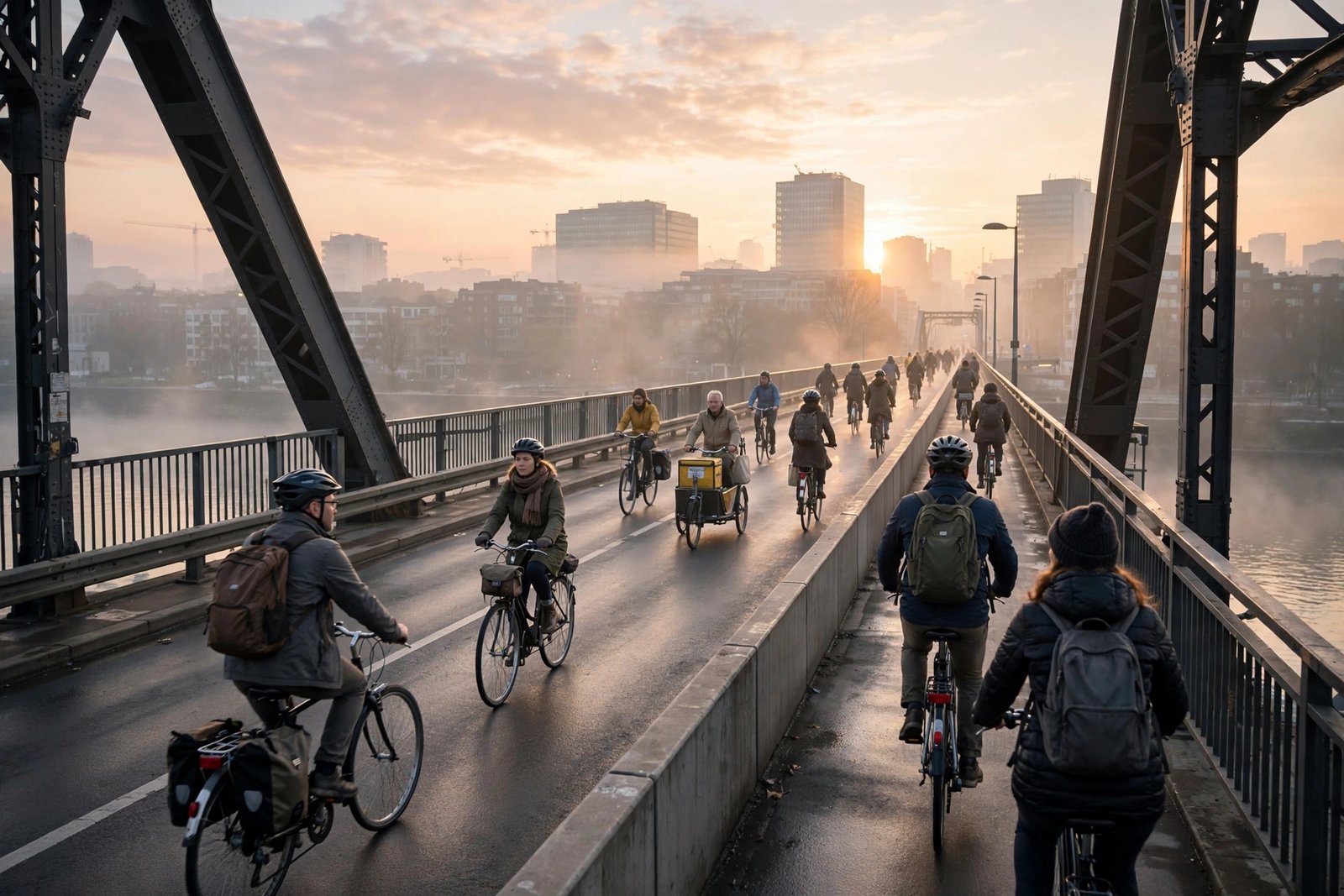
For commutes under ~8km, cycling is the king: near-zero emissions, 30 minutes of exercise disguised as transport, and often faster than driving in congested cities. The barrier is rarely fitness — it’s infrastructure and confidence. The UK’s Cycle to Work scheme saves 25–39% on bikes and equipment through salary sacrifice; many employers now offer e-bike versions, which flatten hills and extend practical range to 15km+. Walking for sub-3km commutes needs no scheme at all. E-bikes deserve special mention: studies show e-bike commuters replace car trips at remarkable rates, because the assistance removes the sweat-and-hills objection.
3. Public transport (bus, train, tram)
A bus emits ~80–100g CO2 per passenger-km; a train ~35–40g — roughly a quarter to a half of solo driving, improving as grids decarbonise and occupancy rises. The economics: cheap rail tickets with a railcard and affordable UK train travel cover the fare-hacking; season tickets, carnets and employer loan schemes cut costs further. The hidden benefit is time quality: a train commute is reading/gaming/rest time; a car commute is stress time. Value that hour properly and the train often wins outright.
4. Share the car (car-sharing, lift-sharing)
Two people in a car halve per-person emissions; four people quarter them. Workplace lift-share schemes (many large employers run them; Liftshare.com matches independently) turn solo commutes into shared ones with minimal organisation. Even one shared day a week cuts 20%.
5. Drive better (eco-driving, then EV)
If the car stays: eco-driving (smooth acceleration, correct tyre pressure, no idling, 55mph not 75mph on motorways) cuts fuel use and emissions 10–20% free. Then the vehicle: a modern hybrid halves the footprint of an old petrol; a full EV charged on the UK grid cuts it ~70% (improving yearly as the grid greens). But the honest hierarchy holds: not driving beats driving electric. An EV is the best car answer, not the best commute answer.
The Money Maths
Commute emissions and commute costs move together — the cheapest commute is usually the greenest. Typical annual comparisons for a 20km each-way commute: solo petrol car ~£2,500–£3,500 (fuel, insurance share, parking, wear); train season ticket ~£1,500–£2,500 (varies wildly by route); cycling ~£200–£400 (maintenance plus amortised bike); walking £0; WFH £0. The cyclist saves ~£2,500 a year and gets fit and cuts 1.5 tonnes of CO2. There are few life changes with a better four-way return.
Overcoming the Real Barriers
“Public transport doesn’t serve my route.” Check again — bus networks change; employer shuttles exist; park-and-ride plus cycle covers the last mile. “Cycling feels dangerous.” Start with one day a week on quieter routes; use the cycle-to-work scheme for lights, locks and hi-vis; many councils offer free adult cycle training (Bikeability for adults). Cycling UK offers route advice and local group rides for new commuters. E-bikes reduce time in traffic. “I need the car for school runs.” The school-run-plus-commute chain is real — but e-cargo bikes now handle it for many families, and staggered start times can decouple the trips. “My employer won’t allow WFH.” Propose a trial (one day a week, three months, measured output) — trials convert sceptics better than arguments. Weather: the Scandinavians are right — there is no bad weather, only bad clothing; £50 of waterproofs solves it.
The 90-Day Transition Plan
Month 1: audit the commute (one week of logging); try the alternative one day a week (cycle Friday, train Tuesday — low commitment, real data). Month 2: scale what worked to 2–3 days; sort the equipment (bike service, railcard, waterproofs); negotiate one WFH day if possible. Month 3: lock in the new default (the goal is making the green option the easy option — bike by the door, season ticket bought, WFH days calendared); measure the new footprint and cost. Most people find month three’s routine unremarkable — which is the point. The best commute change is the one you stop noticing.
Conclusion
Reducing your commute emissions as a beginner is not about buying a Tesla — it is about working the hierarchy: eliminate trips (WFH) first, then active travel, then public transport, then sharing, then driving better. Audit for a week, trial one alternative day, scale what fits, and let the four-way payoff (carbon, cost, health, mood) do the motivating. The 1.5 tonnes are sitting in your week right now, in the most boring hours of it. Reclaim them.
Frequently Asked Questions
What is the greenest way to commute?
Walking and cycling (near-zero emissions), then working from home (zero commute), then trains, then buses, then car-sharing, then efficient solo driving, then EVs. The ranking is stable — active travel and trip elimination beat every technology.
Are e-bikes really green, given the battery?
Yes, overwhelmingly. Lifecycle analyses put e-bike emissions at ~15–25g CO2/km including manufacturing and electricity — roughly a tenth of a petrol car and half of an electric car per km. The battery’s footprint is amortised over thousands of kilometres. They are among the most efficient powered transport ever built.
How do I convince my employer to allow working from home?
Propose a bounded trial: specific days, defined duration (e.g., 3 months), measurable outputs, and a review date. Frame it around productivity and retention evidence, not preference. Offer the commute-emissions angle as a bonus — many employers now have net-zero targets your WFH days directly serve.
Is car-sharing safe with strangers?
Workplace and community lift-share schemes (Liftshare, employer platforms) include profiles, ratings and verification — the risk profile resembles any vetted community activity. Start with colleagues, set clear expectations (timing, costs, backup plans), and trial for a month before committing.
Where can I get help with cycle commuting?
Sustrans (the national cycling charity) offers route planning via the National Cycle Network; most councils provide free adult cycle training; the Cycle to Work scheme (via your employer) discounts bikes and gear. Local cycling campaigns often run “buddy” schemes pairing new commuters with experienced ones for the first rides.