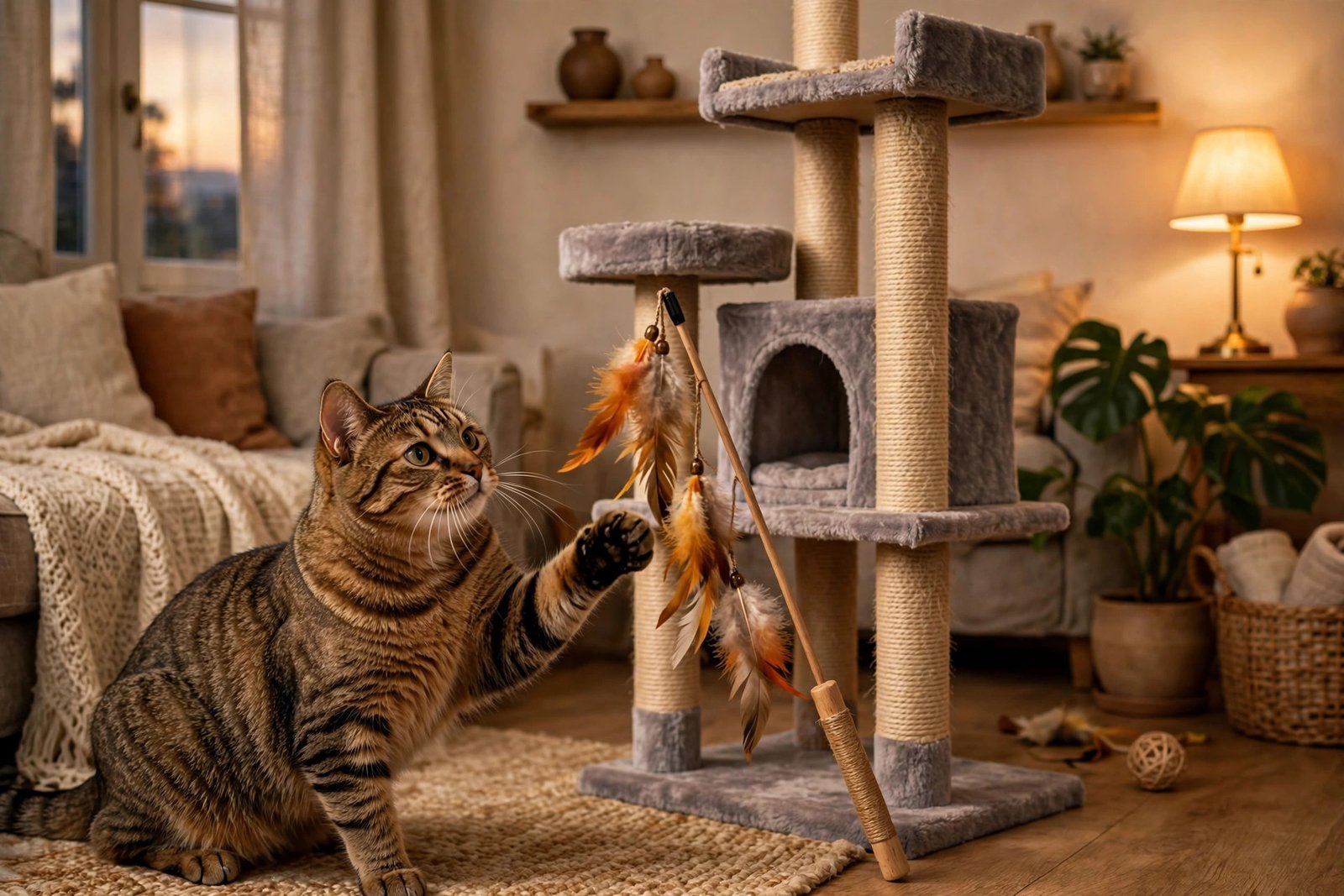
Indoor cats live longer, safer lives than outdoor roamers — no traffic, no fights, no poisons — but only if their indoor world meets their needs. A bored indoor cat is not a happy safe cat; it is a stressed cat expressing misery through overeating, aggression, over-grooming or 3am hallway sprints. The good news: keeping indoor cats happy costs little and mostly involves thinking like a cat. Here is the complete guide.
Think Like a Cat: The Five Needs
Feline behaviourists reduce cat happiness to five provisions: a safe place, multiple separated resources, play and predatory behaviour, positive human interaction, and an environment that respects their senses. Miss any one and problems follow. The safe place means hiding spots — boxes, covered beds, high perches — where the cat can retreat and observe without being reached. Cats do not want constant togetherness; they want the option of it.
Separated resources is the rule multi-cat households break most: food, water and litter trays should be in different locations, not lined up in one utility corner. The formula is one litter tray per cat plus one extra, spread across the home. Water belongs away from food — cats instinctively avoid water near kill sites, so a bowl beside the food bowl gets ignored while the bathroom tap fascinates them. A water fountain (£20–£30) exploits this instinct brilliantly and encourages hydration, protecting against urinary issues.
Predatory Play: The Non-Negotiable
A cat’s brain is wired for the hunt cycle: stalk, chase, pounce, catch, “kill”, eat, groom, sleep. Indoor cats with no outlet for this cycle redirect it onto ankles, curtains and 3am zoomies. The fix is structured play that completes the cycle: 10–15 minutes, twice daily, with a wand toy that mimics prey movement (erratic, hiding behind furniture, never dangled in the face). End each session by letting the cat “catch” the toy, then feed a small meal — hunt, catch, eat, groom, sleep, exactly as nature designed. Most behaviour problems in indoor cats trace back to skipping this.
Rotate toys — cats habituate to the same toy within days. A box of toys in rotation beats a mountain of ignored ones. Catnip, silvervine and puzzle feeders add variety: puzzle feeders make meals into hunts, slowing greedy eaters and engaging clever cats. Scratching posts are not optional furniture; scratching maintains claws, stretches the body and marks territory. Place them where the cat already scratches (not where you wish it would), make them tall and sturdy — wobbly posts get rejected — and consider both vertical and horizontal options.
Vertical Space: The Cheapest Happiness Upgrade
Cats experience square footage vertically. A small flat with shelves, perches and a tall cat tree is a mansion to a cat; a large bungalow with nothing above knee height is a prison. Install a window perch — watching the world is cat television, and a bird feeder outside the window (positioned safely) provides endless enrichment. Wall-mounted shelves create highways; a tall, stable cat tree (£40–£80) is the single best furniture purchase for an indoor cat.
This vertical thinking transforms small-space living for both species — the same principles behind creating cosy corners in a small flat apply: zones, heights and thoughtful layout make compact homes feel generous. If you are setting up for a new arrival, preparing your home for a new pet covers the safety-proofing basics that apply to kittens too.
Routine, Company and the Human Factor
Cats are creatures of habit who pretend not to be. Feed at consistent times, play at consistent times, and keep the household rhythm predictable — cats in chaotic homes show measurably more stress behaviours. Positive interaction means on the cat’s terms: let them initiate, pet where they prefer (most cats favour cheeks and chin over bellies, whatever the invitation looks like), and learn the signals that stroking time is over before the bite teaches you.
Alone-time matters: most adult cats handle a working day alone fine, provided mornings include play and the environment is enriched. Kittens and bonded pairs do better with company — which is why shelters often rehome kittens in pairs. If you are away long hours regularly, two cats are genuinely easier than one: they entertain each other, and the total work barely increases. Cats Protection’s guidance on indoor cats is the UK’s most authoritative free resource for the details.
Health and Weight: The Indoor Risks
Indoor cats’ two big health risks are obesity and urinary issues, both lifestyle-driven. Indoor cats burn fewer calories and beg more convincingly — measure food with scales, not scoops, and follow vet guidance on portions rather than packet optimism. Puzzle feeders and play sessions manage both weight and boredom simultaneously.
Hydration protects the urinary tract: fountains, wet food as part of the diet, and multiple water stations. Litter tray hygiene matters medically, not just socially — dirty trays cause some cats to hold urine, risking cystitis. Scoop daily, full-change weekly, and watch for straining, frequent trips or blood: urinary blockages, especially in male cats, are emergencies measured in hours. Annual vet checks catch the slow changes — dental disease, kidney trends, weight creep — that owners miss day to day. Pet insurance for indoor cats is cheaper than for outdoor, and worth it; one emergency easily exceeds years of premiums.
Introducing a New Cat to Indoor Life
Cats adopted as adults from outdoor backgrounds can transition indoors successfully with patience. Start with one “base camp” room containing all resources, letting the cat establish territory and confidence before gradually opening up the home — a week or two of gradual expansion beats overwhelming them on day one. The RSPCA’s guidance on indoor cat environments details the setup that eases the transition. Expect an adjustment period of a few weeks: some cats test boundaries (door-dashing) before accepting the new arrangement, especially if the outdoors was previously available. Consistency, enrichment from day one, and never punishing the instinct to explore will settle the vast majority. Kittens raised indoors from the start never know what they are missing — which, done right, is nothing.
Conclusion
Happy indoor cats are not deprived cats — they are cats whose humans built a world worth staying in: hiding places and high perches, separated resources, twice-daily hunt-play ending in food, vertical territory, predictable routines and affection on feline terms. None of it is expensive; all of it is transformative. The cat staring out of your window is not plotting escape — if the inside is right, it is just watching television.
Frequently Asked Questions
Are indoor cats unhappy?
Not if their needs are met — indoor cats live significantly longer and avoid traffic, fights and disease. Unhappiness comes from boredom and unmet instincts, both fixable with enrichment, play and vertical space.
How much play does an indoor cat need?
Two structured 10–15 minute sessions daily with prey-mimicking wand toys, ending in a small meal to complete the hunt cycle. Kittens need more; seniors need gentler play but still benefit.
How many litter trays do I need?
One per cat plus one extra, placed in separate locations — not side by side. Scoop daily and full-change weekly.
Should I get two cats instead of one?
For kittens and long working hours, yes — bonded pairs entertain each other and are often easier than a single bored cat. Adult cats with established solo preferences may prefer being only cats; shelters advise on individual cases.
Why does my indoor cat overeat?
Usually boredom rather than hunger. Puzzle feeders, structured play and measured portions address the cause; free-feeding dry food in a boring environment is the classic obesity recipe.