You line up the shot. You miss. Again. In shooter games — Call of Duty, Valorant, Counter-Strike, Apex Legends — aim is the skill gap that feels most personal, because every missed shot is visible and every death has a killcam to prove it. So the question every frustrated beginner asks: should I start grinding aim training now, or wait until I am “good enough” for it to matter?
The answer is now — but probably not in the way you think. Aim training is worth starting immediately, yet the highest-value improvements for a beginner have almost nothing to do with flick shots. Here is the honest breakdown: what aim training actually improves, what beginners should do first, and the point at which dedicated practice starts paying off.
Why “Now” Beats “Later”
The “wait until I’m better” instinct feels logical but gets the skill curve backwards. Aim is a mechanical foundation: everything else in shooters — positioning, game sense, decision-making — sits on top of it. Players who delay aim work build game sense on a shaky foundation, then hit a plateau where their brain knows what to do but their hands cannot execute. Starting early means your mechanics and your game sense grow together.
There is also a compounding argument. Aim improvement follows the classic learning curve: rapid early gains, then diminishing returns. A beginner who starts today will see noticeable improvement within two weeks — steadier tracking, fewer wild misses — because the early gains are the biggest and cheapest. Waiting six months does not make those gains bigger; it just delays them. The British Esports Federation’s grassroots resources make the same point in different words: fundamentals first, and early.
What Beginners Should Actually Do First (It Is Not Aim Trainers)
Here is the part most guides skip: for a true beginner, dedicated aim-trainer software is not the highest-value first step. Three things matter more, and they are all free.
First, fix your settings. An absurdly high mouse sensitivity — the default for most beginners — makes precise aiming physically impossible. Find a sensitivity where a full sweep of your mousepad turns you roughly 180–360 degrees, then stop changing it. Consistency beats “perfect” settings; your muscles need a stable target to learn. Disable mouse acceleration in Windows and in-game. This single change improves most beginners more than a month of aim training.
Second, fix your setup. You cannot aim well at 30fps on a stuttering machine. You do not need elite gear, but a stable 60fps minimum and a mouse that does not spin out matter enormously. If your hardware is holding you back, the priority is the machine, not the practice — and casual-friendly games are a better training ground than competitive ranked modes while you sort it.
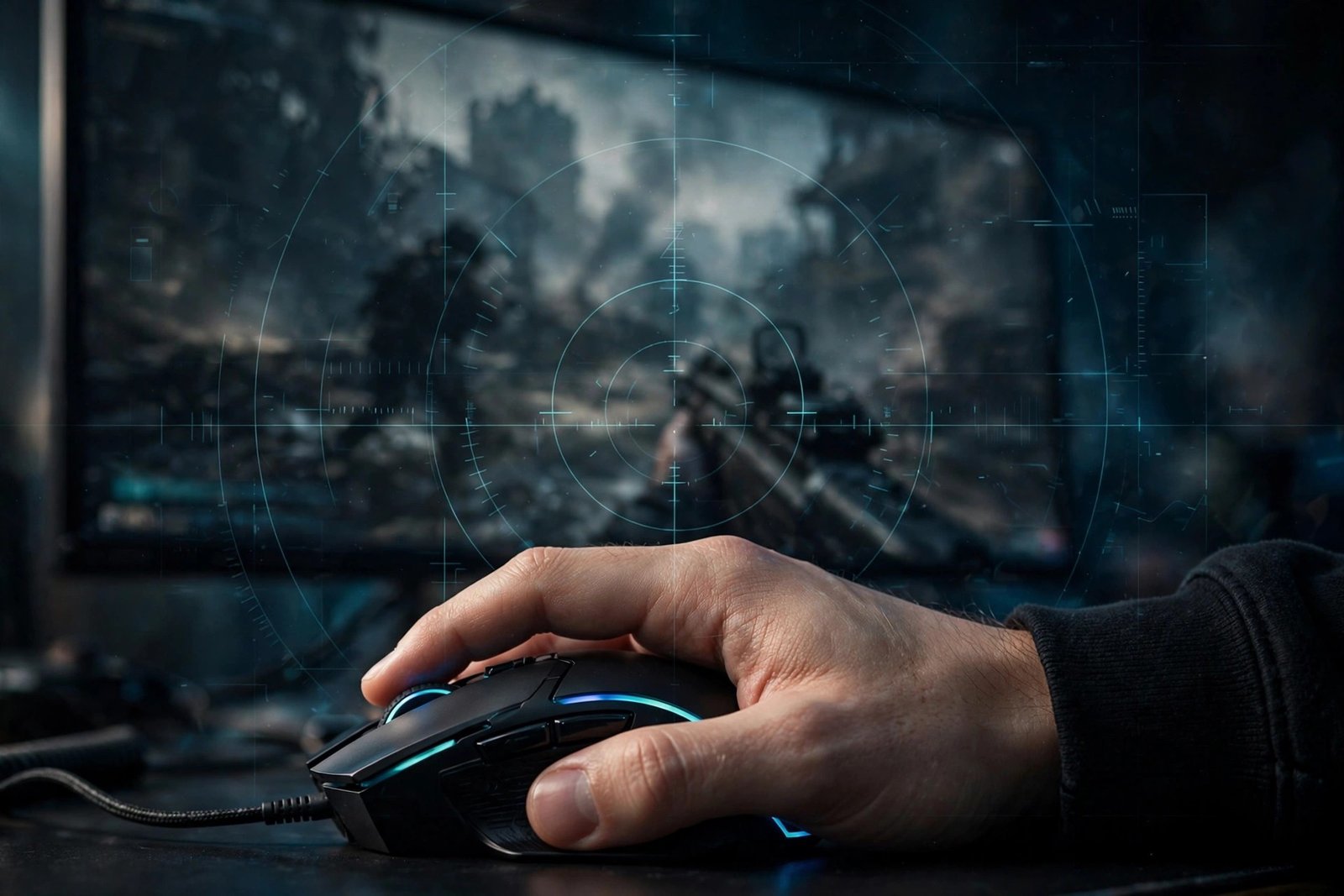
Third, learn crosshair placement. This is the true beginner aim skill, and it is not about reflexes at all: it is the habit of keeping your crosshair at head height, aimed where enemies are likely to appear, before you see them. Good crosshair placement means you barely need to move the mouse when an enemy appears — and it is learned through mindful play, not flick-shot drills. A week of consciously practising placement beats a month of mindless aim-trainer grinding.
When Dedicated Aim Training Starts Paying Off
After two to four weeks of settings, setup, and placement work, dedicated practice earns its place. Aim trainers like Aim Lab (free) offer structured routines: tracking moving targets, flicking between targets, switching smoothly. Fifteen to twenty minutes before playing — as a warm-up, not a replacement for playing — is the sweet spot the evidence supports.
What improves, specifically: mouse control (smooth, precise movement), target switching (moving efficiently between multiple enemies), and click timing (firing exactly when the crosshair arrives, not before or after). What does not improve much from trainers: game sense, positioning, and decision-making — those only come from playing actual matches. The players who stagnate are usually the ones who train aim for an hour and play for twenty minutes. Invert that ratio.
The Mental Game: Tilt, Focus, and Quitting Smart
Aim guides love mechanics and ignore psychology, which is backwards: most beginners lose gunfights to their own frustration, not their opponents. “Tilt” — the spiral where missed shots breed tension, tension wrecks aim, and wrecked aim breeds more misses — destroys more practice sessions than any settings problem. The fix is structural, not motivational: play in blocks with breaks, stop a session when frustration rises instead of “playing through it,” and track progress weekly rather than per-match. One bad evening means nothing; the trend over a month means everything.
Focus technique matters too. Beginners aim with their eyes darting everywhere — minimap, kill feed, teammate positions — while their crosshair drifts. The drill is simple: in each fight, look only at your crosshair and the enemy. Narrow the visual field deliberately. It feels unnatural for a week, then becomes automatic, and your hit rate jumps because your attention is finally where your mouse is. And know when to step away entirely: aim is a perishable skill, but burnout kills motivation faster than rust kills mechanics. The players who improve for years are the ones who kept it fun.
The Honest Timeline
Set expectations correctly and you will not quit. Week 1–2: settings fixed, crosshair placement consciously practised — you will feel clumsy as old habits fight new ones. Week 3–6: the biggest visible jump — steadier aim, fewer panic sprays, noticeably better duels. Month 3+: diminishing returns on raw aim; further improvement comes from game sense and positioning, with aim maintained by warm-ups. Most beginners who follow this path go from “liability” to “solid contributor” in six to eight weeks — not pro, but genuinely competent, which is all most people want.
One more honest note: some of it is hardware-capped. A 60Hz monitor and office mouse have a ceiling; you will feel it around month two or three. That is the right time to consider upgrades — not before, when settings and habits are the real limiters. And if shooters are not clicking at all, there is no shame in it: retro and family games offer entirely different — and equally valid — kinds of fun.
The Bottom Line
Is now a good time to start improving your aim in shooter games? Yes — the early gains are the biggest, and mechanics compound with game sense. But start with settings, setup, and crosshair placement, not aim-trainer marathons. Fifteen focused minutes of warm-up plus mindful play will take a beginner further in two months than most players get in a year of unfocused grinding. And check PEGI ratings before picking your shooter — many of the most competitive titles are 16+ or 18+ for good reason.
Frequently Asked Questions
How long does it take to get good aim in shooters?
Noticeable improvement in 2–4 weeks with correct settings and crosshair placement practice; solid competence in 6–8 weeks. Reaching genuinely high-level aim takes many months, but most casual players do not need it.
Are aim trainers like Aim Lab worth it for beginners?
As a 15-minute warm-up after fixing settings and learning crosshair placement, yes. As a replacement for playing the actual game, no — game sense only comes from real matches.
What mouse sensitivity should I use for shooters?
Low enough that a full mousepad sweep turns you 180–360 degrees — far lower than defaults. There is no universal number; the key is picking one sensitivity and never changing it, so muscle memory can build.
Does a better monitor improve aim?
Yes, measurably — higher refresh rates (120Hz+) show enemy movement sooner and smoother. But it is a multiplier on fundamentals, not a substitute: a 240Hz monitor will not fix bad crosshair placement.