Sourdough has a reputation problem: online guides read like chemistry textbooks crossed with mysticism, full of hydration percentages and autolyse windows. When people ask how can I bake sourdough bread for beginners, I tell them the truth — your first loaf needs flour, water, salt, a starter, and patience. The percentages can wait.
I baked my first sourdough during lockdown like everyone else, killed one starter, revived another, and now bake weekly without thinking about it. Here’s the demystified method: the starter, a schedule that fits real life, and the techniques that actually matter.
How can I bake sourdough bread for beginners? Start with the starter
A starter is just flour and water, fermented — wild yeasts and bacteria doing the rising instead of commercial yeast. To make one: mix 50g wholemeal flour with 50g water in a jar, leave it loosely covered at room temperature, and feed it daily (discard half, add 50g flour + 50g water). By day 5–7 it should bubble, rise and fall predictably, and smell pleasantly tangy — that’s a live starter. (Or skip the week: ask a baking friend for a spoonful of theirs, or buy a dried starter online for a few pounds. No shame in it.)
Maintain it simply: if you bake weekly, keep it in the fridge and feed it once a week; the night before baking, feed it and leave it out — a starter that doubles in 4–6 hours after feeding is ready to bake with. The float test (a spoonful should float in water) is a decent readiness check. Name it if you like — everyone does — but don’t overthink it. Starters are resilient; they survive neglect, holidays in the fridge, and most beginner mistakes.
- Day 1–7: daily feeds of flour + water until bubbly and doubling
- Ready test: doubles in 4–6 hours, floats in water
- Weekly bakers: fridge it, feed weekly, feed night before baking
- Beg, borrow or buy a starter to skip the first week
- Starters are tough — neglect rarely kills them
Your first loaf: the simple schedule
Here’s a beginner recipe that works: 500g strong white bread flour, 350g water, 100g active starter, 10g salt. Saturday morning: mix flour and water, rest 30 minutes; add starter and salt, squish to combine. Over the next 4 hours, do 4 sets of ‘stretch and folds’ (wet hands, pull each side up and fold over, rotate the bowl — 30 seconds each, once an hour). This builds structure without kneading. Then leave it alone 2–4 more hours until grown ~50% and jiggly.
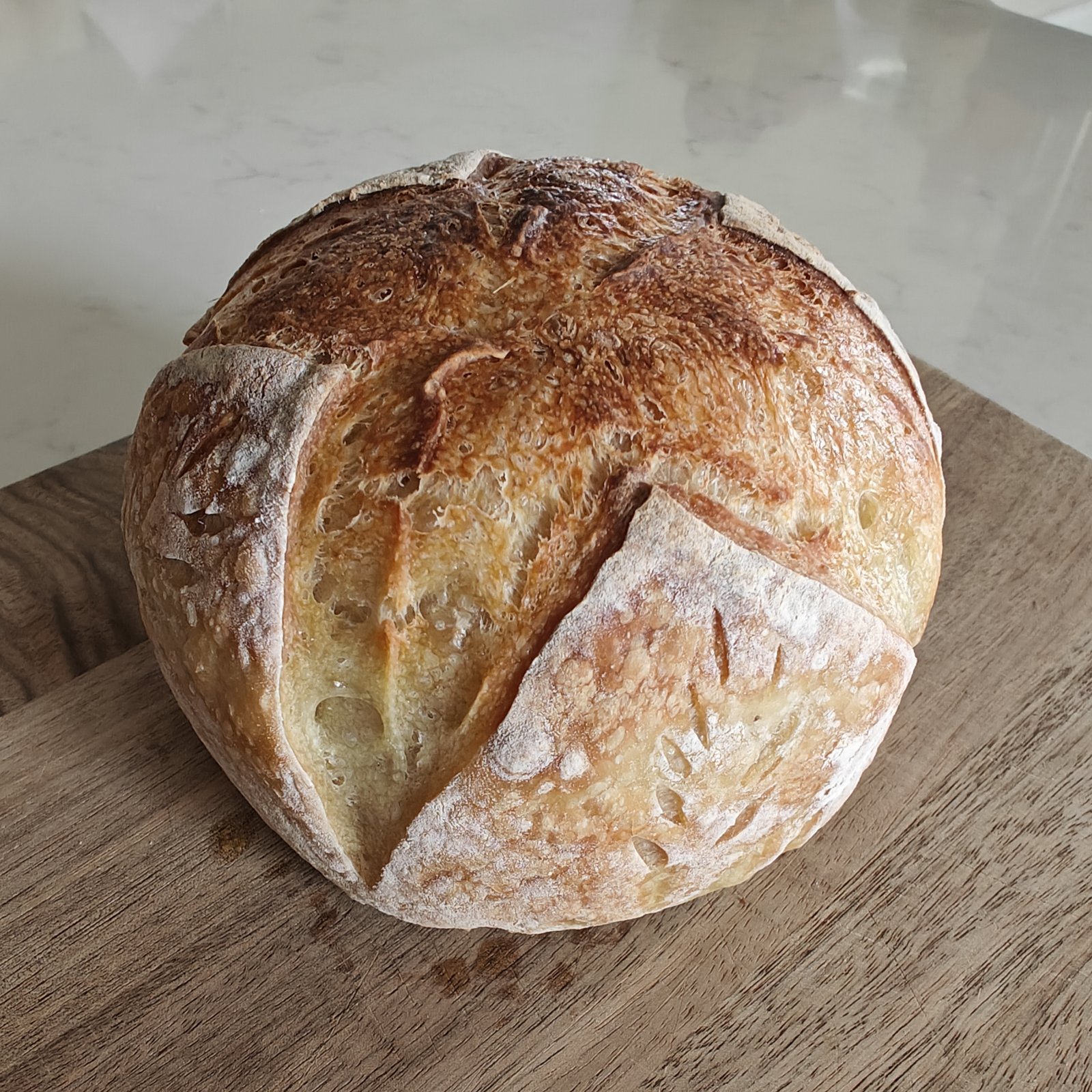
Shape it: tip onto a floured surface, fold edges to centre, flip seam-down, and drag toward you to tighten the surface into a ball. Place seam-up in a floured bowl or banneton, cover, and refrigerate overnight — the cold retard develops flavour and firms the dough for scoring. Sunday morning: preheat the oven to max with a lidded pot (Dutch oven) inside for 45 minutes. Turn the loaf onto baking paper, score a confident slash with a sharp knife, lower into the screaming-hot pot, lid on, bake 20 minutes; lid off, 20–25 more until deeply browned. Cool 2 hours before slicing — cutting early gives gummy crumb, and the wait is the hardest part.
Troubleshooting the beginner loaves
Dense and flat? The starter wasn’t active enough, or the bulk ferment was too short — watch the dough, not the clock; it should grow visibly and feel airy. Huge holes with dense patches? Under-mixed or under-folded — be a bit more assertive with the stretch-and-folds. Gummy crumb? Cut too soon, or underbaked — go darker than you dare; pale sourdough is underbaked sourdough, and a deep mahogany crust is where the flavour lives. Stuck to the banneton? More rice flour in the basket next time (rice flour doesn’t absorb like wheat flour).
And the two beginner truths: your first three loaves will be ugly and delicious — eat them proudly — and sourdough is far more forgiving than the internet suggests. The overnight fridge step is your friend: it makes the schedule flexible (bake Sunday or Monday, the dough waits), develops the tangy flavour, and turns a finicky process into something that fits around a weekend. By loaf five, you’ll be shaping without thinking and wondering what all the fuss was about.
Beyond the basic loaf: variations and next steps
Once the basic white loaf is reliable, the variations open up. Wholemeal and seeded: replace up to 30% of the white flour with wholemeal, spelt or rye, and add seeds (sunflower, pumpkin, linseed) — thirstier flours need a splash more water, added gradually. Olive and herb, walnut and honey, cheddar and jalapeño — add-ins go in during the last stretch-and-fold, a handful at a time. Pizza from sourdough starter: the discard (the bit you’d throw away at feeding) makes superb pizza dough, crackers and pancakes — the no-waste sourdough kitchen.
The next-level techniques, when you’re ready: higher hydration (75–80% water — wetter dough, more open crumb, trickier handling), the aliquot jar method (a small sample of dough in a straight-sided jar shows the rise precisely — no more guessing the bulk ferment), and scoring art (the ear comes from a confident 30° angled slash with a wet blade; decorative scores need a light touch and a floured surface). But the real next step isn’t technical — it’s rhythm. The bakers who bake weekly for a year develop an intuition no recipe teaches: the dough tells you when it’s ready, and you just know. Bake the tenth loaf, then the fiftieth. The journey is the point.
- Wholemeal/seeded: swap up to 30% flour, add water gradually
- Discard recipes: pizza dough, crackers, pancakes — zero waste
- Higher hydration (75–80%) for open crumb when ready
- Aliquot jar: precise bulk-ferment tracking
- Bake weekly — intuition beats recipes by loaf fifty
Your sourdough journey starts here
Get or grow a starter, follow the simple Saturday-to-Sunday schedule, bake it darker than feels safe, and cool it properly. The first loaf won’t win awards; the tenth might. Sourdough rewards persistence more than precision — start, and keep going.
For easier bread first, make homemade bread without a bread maker needs no starter at all, and make fluffy pancakes from scratch builds baking confidence with pancakes. For recipe variations, BBC Good Food’s recipe collection has excellent sourdough guides.
The sourdough life: a jar in the fridge, a loaf in the week, toast that ruins shop bread forever. It’s a small commitment — ten minutes of actual work per loaf — for one of cooking’s deepest satisfactions. The starter becomes a pet, the bread becomes a habit, and the kitchen becomes a bakery.