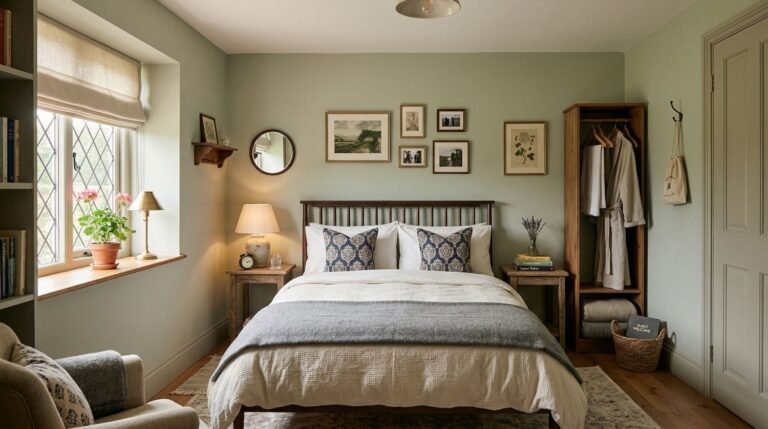
The box room: too small for a proper bedroom, too useful to waste, currently full of things you don’t know where else to put. When people ask how can I turn a box room into a guest bedroom, they want to know if it’s even possible — a 2m x 2.4m room with a single bed sounds like a punishment cell.
It’s absolutely possible. I’ve turned two box rooms into guest bedrooms that visitors genuinely compliment — one sleeps a couple in comfort. The secret is treating every centimetre as precious and every choice as dual-purpose. Here’s the complete method.
How can I turn a box room into a guest bedroom? The bed decision
The bed is 80% of the room, so choose ruthlessly. A standard double (4’6″) overwhelms most box rooms; a small double (4’0″ x 6’3″) sleeps two in much less space and is the sweet spot for guest rooms. Better still: an ottoman small double gives you the bed plus the equivalent of a chest of drawers underneath — in a box room, that’s transformative. Day beds and futons are the flexible option: sofa by day (if the room doubles as an office), bed by night — but be honest about how often it’ll be a sofa versus how often guests need a proper bed.
Position the bed against the longest wall, ideally under the window — it frees the remaining walls for storage and feels cosier than you’d expect. Leave at least 50cm clearance on one side for getting in and out; if you can’t manage both sides, one side is fine for a guest room (hotels do it with twins). And invest in the mattress: guests forgive a small room, they don’t forgive a bad bed. A £300 small-double mattress beats a £150 full-size one for actual sleep.
- Small double (4’0″) or ottoman bed — best use of space
- Bed against the longest wall, ideally under the window
- 50cm clearance minimum on one side
- Spend on the mattress — guests forgive small, not uncomfortable
- Quality bedding in white: looks bigger, feels hotel-like
Storage without swallowing the room
A guest room needs less storage than you think — guests bring a bag, not a wardrobe. One narrow wardrobe or a clothes rail with a curtain, a couple of empty drawers, and hooks on the back of the door cover 95% of visits. Wall-mounted shelves above the bed hold books and a clock without touching the floor. The mistake is installing full bedroom storage in a guest room — it eats the space guests actually need to move and breathe.
If the box room must also store household stuff (and it usually must), zone ruthlessly: one wardrobe or cupboard for household overflow, clearly separated, and the rest of the room genuinely for guests. Ottoman bed storage swallows the bulky spare bedding and towels. Under-eaves or over-door shelving takes the rarely-needed. The test: can a guest unpack a weekend bag, hang up clothes, and charge their phone by the bed? If yes, the storage is right.
Light, colour and the welcoming touches
Small rooms need light discipline: pale walls (warm white, not brilliant), a mirror opposite the window to double the light, and curtains hung high and wide to maximise the window. Lighting should be layered even here — a pendant plus a bedside lamp minimum; guests reading in bed with only a ceiling light is miserable. A dimmer or a warm bedside lamp makes the tiny room feel cosy rather than cramped. Keep the floor visible: no clutter, a small rug rather than wall-to-wall busyness.
The touches that make guests feel welcome cost almost nothing: proper bedside tables (or wall-mounted shelves) both sides with a lamp, a phone charger, and a glass; empty hangers in the wardrobe; fresh towels folded on the bed; the wifi password in a frame; and a little space — an empty drawer, a clear surface — that says ‘this room is for you’. These details take a box room from ‘spare room with a bed’ to ‘they thought about me’, which is the whole difference.
The multifunctional box room: guest room plus
Most box rooms must earn their keep twice — guest bedroom plus home office, or guest room plus storage. The trick is designing for the primary use while accommodating the secondary invisibly. Guest room + office: the wall-mounted drop-leaf desk from the home-office guide folds away when guests come, the office chair swaps for the room’s accent chair, and paperwork lives in one lidded box on the wardrobe shelf. Fifteen minutes converts it. The key: nothing about the office should intrude on the guest experience — no visible files, no cables, no ‘sorry about the mess’.
Guest room + hobby space (sewing, crafts, music): zone with furniture — the hobby zone gets the desk and storage wall, the guest zone gets the bed wall, and a folding screen or curtain divides them when guests stay. Storage must be closed, not open: hobby clutter in open shelves makes guests feel they’re intruding on someone’s workshop. The universal rule for dual-use box rooms: the conversion from one mode to the other should take under 20 minutes, or it won’t happen — and the room will default permanently to whichever use is messier.
- Drop-leaf desk + lidded paperwork box = office that vanishes
- Zone with furniture; divide with screen when guests stay
- Closed storage for the secondary use — no open hobby clutter
- 20-minute conversion rule: slower won’t happen
- Guest experience first — no ‘sorry about the mess’
The box room that works
Small-double ottoman bed, minimal but real storage, pale walls with layered light, and the hotel touches (charger, wifi code, fresh towels). Under £1,000 all-in for a guest room people actually enjoy — and the box room finally earns its keep.
For squeezing storage into any small bedroom, maximise storage in a small uk bedroom is the master guide, and create a home office in a spare corner covers adding a home office corner. For budget guest-room finds, MoneySavingExpert’s household money-saving tips is full of clever deals.
The box-room triumph: a room that sleeps guests beautifully, works as an office daily, and stores the household overflow invisibly. It demands ruthless design and honest prioritising — but the smallest room in the house can become its hardest-working, and there’s a particular satisfaction in that.