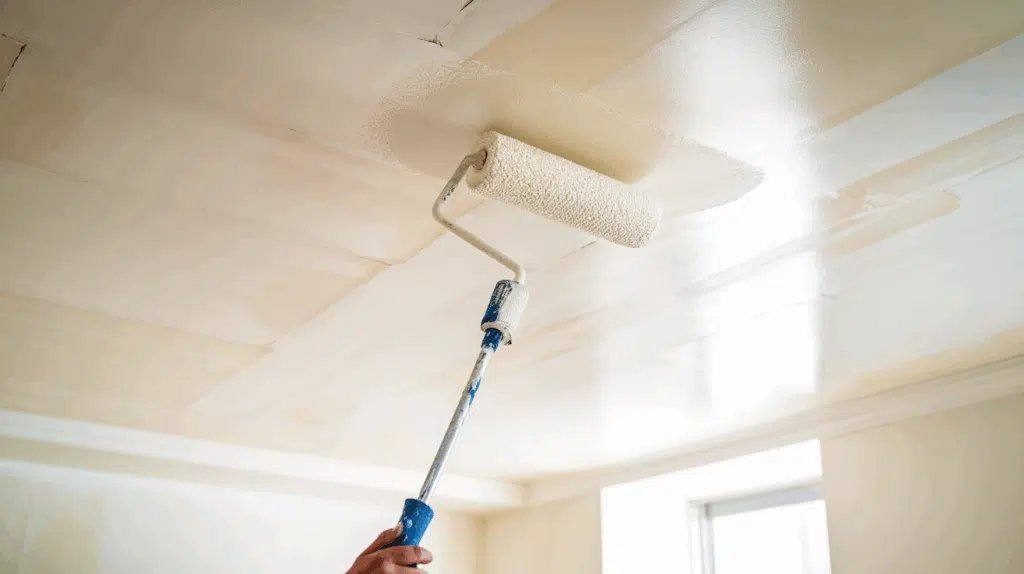
Ceilings are the cruellest surface in decorating: every lap mark, roller line and patch shows up the moment the light hits it. When people ask how do I paint a ceiling without getting streaks, they’ve usually just finished a ceiling that looked fine while wet and terrible by morning.
I’ve painted nine ceilings — the learning curve was steep and is now complete. Here’s the professional method: the technique, the tools, and the mistakes that cause every streak you’ll ever see.
How do I paint a ceiling without getting streaks? The wet-edge rule
Almost every ceiling streak comes from one cause: painting over paint that’s started to dry. The fix is the wet-edge rule — always work into the wet edge of the last section, never letting an edge dry before you overlap it. In practice: work in 1m-wide strips across the ceiling’s shortest dimension, rolling each strip fully (two passes) before moving on, and overlapping the previous strip by 5cm while it’s still wet. On a large ceiling, this means moving briskly and not stopping for tea mid-wall.
Load the roller properly: dip, roll off the excess on the tray’s ribbed section (the roller should be evenly coated, not dripping), and apply with light, even pressure in overlapping ‘W’ or ‘M’ strokes, then lay off — one final light pass in a single direction over the whole strip. Pressing hard squeezes paint out unevenly and causes the tramlines people mistake for bad paint. Two thin coats always beat one thick coat; the second coat, applied after the first is fully dry (4+ hours), is what delivers the uniform finish.
- Work in 1m strips, always into the wet edge
- Light even pressure — never press hard on the roller
- ‘W’ strokes then one lay-off pass in a single direction
- Two thin coats, not one thick one
- Keep moving — no breaks mid-ceiling
Tools and paint that make it easier
The right roller matters enormously: use a 9-inch roller with a medium-pile sleeve (12–15mm) for flat ceilings — short pile for smooth plaster, longer for textured. Cheap foam or thin sleeves cause streaking; a quality microfibre sleeve (£8–£12) holds paint evenly and releases it smoothly. An extension pole is non-negotiable — it keeps your strokes even (no more pressing harder when your arm tires) and saves your neck. Cut in the edges with a 2-inch angled brush, but do it one wall at a time, rolling up to the wet cut-in before it dries.
Paint choice: use a dedicated ceiling paint, not wall emulsion. Ceiling paints (Dulux Magic White, Johnstone’s Ceiling Paint) are formulated thicker to reduce splatter, with a dead-flat finish that hides imperfections — wall matt on a ceiling shows every flaw. The pink-to-white colour-change paints sound gimmicky but genuinely help you see missed patches. And buy enough: a 10L tin covers ~130m² per coat in theory, ~100m² in practice — running out mid-ceiling and continuing with a different batch is a classic streak cause (batch variation is real).
Lighting, preparation and the final check
Prep like a professional: sugar-soap the ceiling (kitchens and bathrooms especially — grease and nicotine bleed through), fill cracks, sand the filler smooth, and spot-prime stains with stain block. Cover everything — ceiling paint travels further than you think — and remove light fittings or mask them carefully. Temperature matters too: paint between 10°C and 25°C; too cold and it won’t flow, too hot and the wet edge vanishes in minutes. Close windows to stop draughts drying the edge, but ventilate between coats.
The final check is brutal and necessary: once dry, shine a bright light across the ceiling at a low angle (a phone torch held sideways works) — this reveals every flaw invisible in normal light. Touch up now, not after you’ve put the furniture back. And accept one truth: the first ceiling you paint will have a flaw you’ll see forever and no visitor will ever notice. By the third, you’ll be laying off like a decorator.
Textured, tall and awkward ceilings
Artex and textured ceilings need a thicker roller sleeve (18–25mm pile) to get paint into the texture — and more paint, roughly 30% extra. Don’t over-roll textured surfaces; lay the paint on generously and leave it — overworking pushes paint around without improving coverage. Pre-2000 Artex may contain asbestos: don’t sand it. If it’s sound, paint over it; if it’s damaged, get it tested (£40) before disturbing. The colour-change ceiling paints are especially useful on texture, showing missed patches clearly.
Tall ceilings (Victorian 3m+ monsters) need the extension pole fully extended and a step ladder for cutting in — or better, a scaffold board between two step ladders for safe, stable access along the whole wall. Work in narrower strips (60–80cm) because the wet edge dries faster when you’re covering more distance. And loft-conversion sloping ceilings: paint them the same as the walls (colour-drenching) rather than white — the slopes become a feature instead of an awkward afterthought, and you avoid the impossible cut-in line where slope meets wall.
- Textured ceilings: long-pile sleeve, 30% more paint, don’t over-roll
- Pre-2000 Artex: never sand — test for asbestos if damaged
- Tall ceilings: full extension pole + stable platform, narrower strips
- Sloping loft ceilings: drench in wall colour, skip the cut-in line
- Colour-change paint shows misses on texture
The streak-free ceiling
Quality roller and extension pole, dedicated ceiling paint, wet-edge discipline in 1m strips, light pressure, two thin coats, and a raking-light final check. It’s 80% technique and 20% materials — and the technique is just ‘don’t let it dry mid-strip’.
For the walls to match, what colour should I paint a small dark living room covers colours for dark living rooms and best paint for kitchen walls that gets greasy tackles greasy kitchen walls. For paint reviews, Which? home improvement guides tests them rigorously.
The ceiling-painter’s confidence: every ceiling is paintable, every streak is preventable, and the method never changes — right tools, wet edge, thin coats, raking-light check. Master it once and you’ll never dread the fifth wall again. In fact, you might even volunteer.