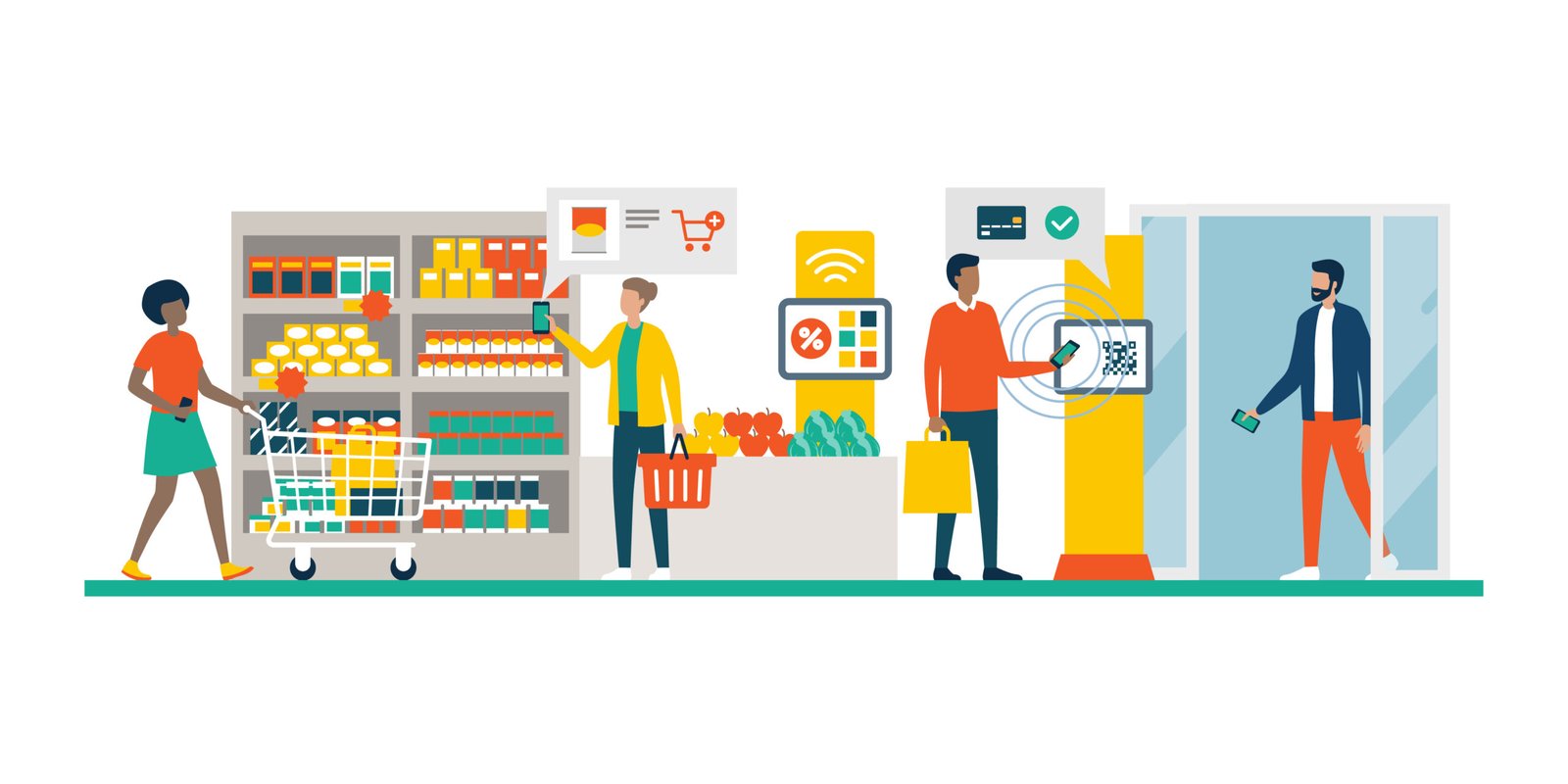
Asking how will ai change supermarkets and high street shopping is really asking what your weekly shop will look like in five years — and the answer is: mostly familiar, but with AI woven through everything behind the scenes. I’ve watched my local Tesco transform over the past few years — self-checkouts everywhere, electronic shelf labels appearing, the app knowing what I buy before I do — and that’s just the visible surface. The deeper changes are in the supply chain, the pricing, and the slow reinvention of what a shop is for.
Let’s walk through what’s changing, what’s hype, and what it means for how you shop.
How will AI change supermarkets and high street shopping?
1. The shop that knows you (personalisation)
Supermarket apps already use AI to personalise offers — Tesco Clubcard Prices and Sainsbury’s Nectar Prices show you discounts based on your purchase history. This is just the start: expect increasingly tailored meal suggestions (“you buy chicken every Tuesday — here’s a recipe using what’s on offer”), automated shopping lists that predict what you’ve run out of, and personalised pricing within loyalty schemes. Our guide to how shops use AI to set prices covers the mechanics.
2. Frictionless checkout
Amazon Fresh’s “just walk out” technology — cameras and AI tracking what you take — has had a mixed rollout (it turns out humans were reviewing more footage than advertised), but the direction is clear. More practical near-term: scan-as-you-shop apps getting smarter, self-checkouts with AI that actually recognises your loose apples, and queue-prediction that staffs tills before the rush. The goal is the death of the queue — the single most hated part of supermarket shopping.
3. The invisible supply chain revolution
This is where AI matters most and you notice it least. Demand forecasting AI predicts what each store needs down to the product and day — factoring in weather, local events, even social media trends. The result: fewer empty shelves, less food waste (a huge UK problem — we waste millions of tonnes annually), and fresher produce. Dynamic markdown AI optimises yellow-sticker reductions to clear stock with minimal loss. You experience this as “the shelves are always stocked and the reductions are well-timed” — boring, transformative.
4. The high street fights back with experience
Here’s the interesting counter-trend: as online and supermarket AI handles the transactional shopping, the high street’s survival strategy is becoming experience — the things AI can’t do. Independent shops offering curation, expertise, community, and the pleasure of browsing. The bookshop that recommends your next favourite novel, the butcher who knows your Sunday roast preferences, the café that’s a third place. AI actually helps here too — see our AI marketing guide for small shops — by letting independents punch above their weight on the business side while doubling down on the human side.
5. What to watch with a sceptical eye
- Surveillance creep: cameras tracking your movement, facial recognition trials, data collection through apps. Convenience has a privacy cost — know what you’re trading.
- Dark patterns: AI-optimised store layouts and app designs that nudge you to spend more. Personalisation serves the retailer’s goals first.
- Food deserts and access: if AI-optimised retail concentrates on profitable areas and demographics, vulnerable communities lose out. Technology needs policy alongside it.
- Job impacts: checkout and shelf-stacking roles are genuinely exposed — the same dynamics as our customer-service analysis, applied to retail.
The high street’s secret weapon: what AI can’t replicate
Amid all the automation, it’s worth naming what the high street has that no algorithm can reproduce: serendipity, community, and human expertise. The bookshop browser’s joy of finding an unexpected treasure. The market trader who remembers your name and throws in the extra apple. The independent clothes shop where the owner tells you honestly that the jacket doesn’t suit you. These aren’t inefficiencies to be optimised away — they’re the entire reason physical retail survives, and they’re getting more valuable as digital life gets more algorithmic.
Smart high-street businesses are leaning into this deliberately. The shops thriving aren’t competing with Amazon on price or convenience — they’re offering what Amazon structurally can’t: curation by someone with taste, advice from someone with expertise, and the social pleasure of being somewhere. Add AI behind the scenes for the unglamorous stuff (stock management, marketing, bookkeeping) and you’ve got the best of both worlds: human front, machine back.
As a shopper, consider what your high street is for in your life. If the answer is “nothing I can’t get online cheaper”, that’s a signal — but for most people, the answer includes things worth preserving: the Saturday browse, the trusted local experts, the community hub. The British Chambers of Commerce research on high streets consistently shows that places thrive when they offer experience and community, not just transactions. Use the AI conveniences, by all means — but occasionally choose the human option deliberately. The high street you save may be your own.
One more prediction worth making: the checkout-free store will come to the UK high street gradually, then suddenly. The technology works; the economics are improving; and the generation that grew up with smartphones finds queuing increasingly absurd. Expect hybrid models first — scan-as-you-shop perfected, self-checkout improved, then fully frictionless in new-build stores. The interesting question isn’t whether but what it does to the experience: without the checkout interaction, stores need new reasons for human contact — tastings, advice, community spaces. The till was never just a transaction point; it was the moment of human connection. Replacing it means reinventing that connection elsewhere.
Your practical takeaway
As a shopper: use the personalisation (loyalty apps genuinely save money if you’re savvy), but stay aware of the nudges — shop with a list, compare prices, and know your data is the price of the discount. As a high-street business: let AI handle your operations and marketing efficiency while investing everything in the human experience that algorithms can’t replicate. The future of shopping isn’t fully automated or fully traditional — it’s AI handling the logistics invisibly while humans handle the parts that make shopping actually enjoyable.