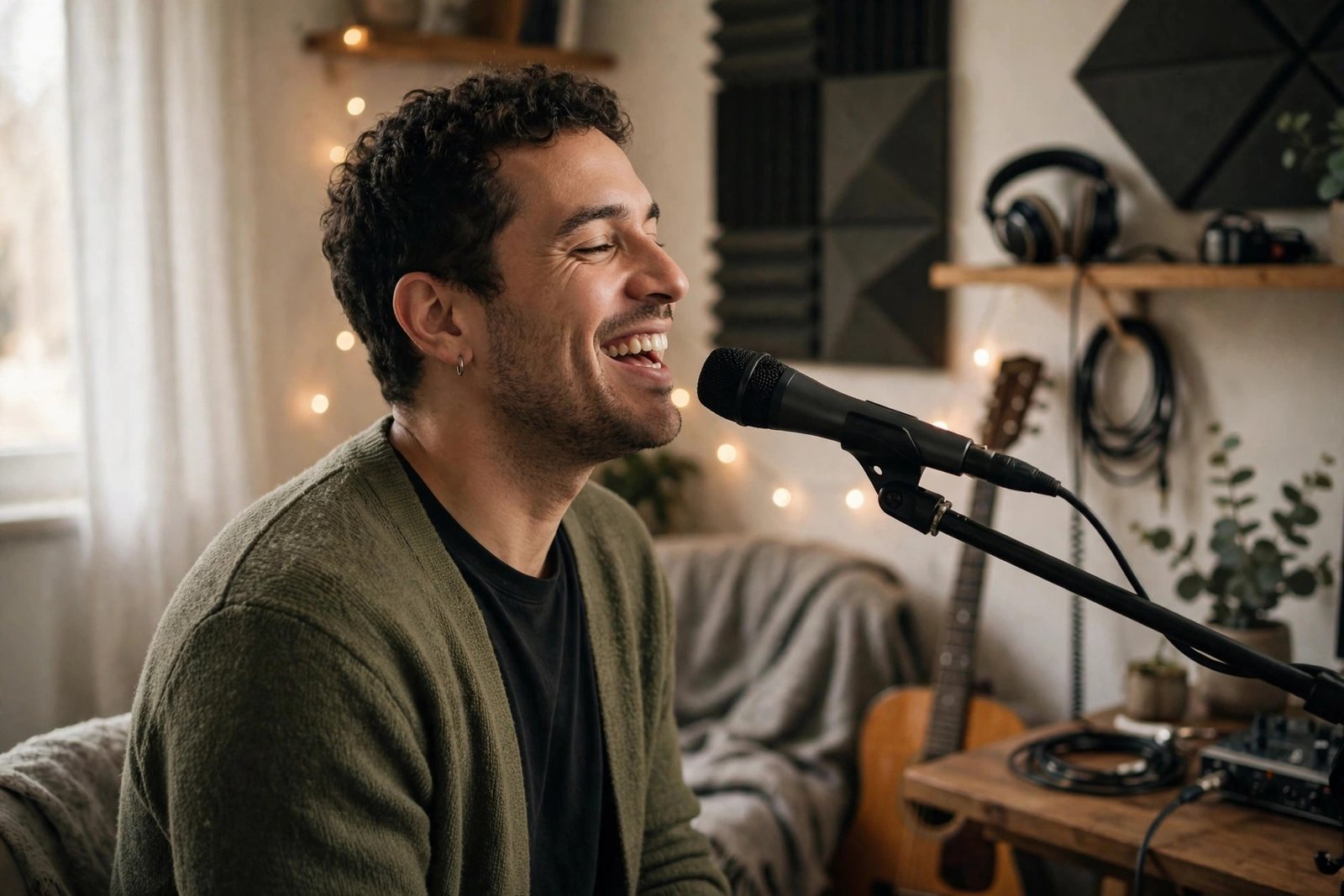
You love singing — in the car, in the shower, along with the radio. But the moment you try to sing in tune, deliberately, it falls apart. Notes wobble, pitch drifts, and the gap between what you hear in your head and what comes out of your mouth feels unbridgeable. So the question: can you actually learn to sing in tune, and can you do it on a tight budget in Swansea without expensive lessons?
Yes to both — with one important qualification. The vast majority of people can learn to sing in tune; true tone-deafness (amusia) affects only about 4% of the population. What most people call “can’t sing” is actually “haven’t trained” — pitch matching is a learnable skill, like any other. And the training is mostly free. Here is the complete budget path.
Why You Sing Out of Tune (It Is Not What You Think)
Understanding the mechanism removes the shame. Singing in tune requires a loop: hear the target pitch, compare it with what you are producing, adjust your vocal muscles to close the gap. Most “bad singers” have a weak link in this loop — usually the comparison step. They literally cannot yet hear the difference between the target note and their own note, so no amount of effort fixes it. This is not a character flaw; it is an untrained ear.
The good news: the loop strengthens with practice like a muscle. The ear learns to discriminate smaller pitch differences; the vocal muscles learn finer control. This is why children in choir programmes develop pitch accuracy naturally — not because they are talented, but because they practise the loop daily. Adults can build the same loop; it just needs deliberate exercise rather than incidental exposure.
The £0 Foundation (Weeks 1–4)
The entire foundation is free. Pitch-matching drills: play a single note on a free piano app, sing it back, and check yourself — first with the note sustained underneath you (easy), then with it removed (harder). Ten minutes daily. Free apps with real-time pitch display show your sung pitch against the target visually — the visual feedback accelerates the ear-training enormously, because you see the gap you are learning to hear.
Record yourself relentlessly. Your phone’s voice recorder is the most honest teacher you will ever have — the voice you hear in your head (conducted partly through your skull bones) differs wildly from what others hear. Recording collapses that gap. It is uncomfortable for everyone at first; it is also the fastest route to accuracy. Sing along with simple songs — nursery rhymes, folk songs, hymns — whose melodies move in small steps. Complex pop melismas are advanced territory; start where the intervals are kind.
Swansea’s free resources: the Central Library’s music section, community choir taster sessions (many Welsh choirs welcome beginners free for trial periods — and Wales takes choirs seriously), and university music society open events. The BBC Bitesize music pages cover the pitch and melody fundamentals clearly.
The Budget Upgrades (£10–£80)
If free practice stalls, small spends unlock the next level. A few lessons (£25–£40 each in Swansea): even two or three sessions with a good teacher diagnose problems you cannot hear yourself — breath support, tension, vowel shaping — that unlock months of self-practice. This is the highest-value spend in singing: targeted expert diagnosis beats a year of guessing. A beginner singing book (£10–£15) with structured exercises gives your daily practice a curriculum. Choir membership (£0–£50/year): many community choirs are free or nominal — and singing weekly in a group, surrounded by in-tune voices to lock onto, is the single most effective pitch training that exists. Your ear calibrates to the section around you automatically.
The choir route deserves emphasis for Swansea specifically: South Wales has one of the world’s great choral traditions, and beginner-friendly community choirs actively recruit. It is social, joyful, and pedagogically ideal — pitch matching learned in the context of real music, with expert direction, for essentially nothing.
The Timeline: When Results Arrive
Set honest expectations. Weeks 1–4: you start hearing your own pitch errors — frustrating, but it is the crucial first result; you cannot fix what you cannot hear. Months 2–3: simple melodies start landing in tune consistently; pitch-matching drills feel easier. Months 4–6: you can hold a harmony line in a choir and sing familiar songs recognisably in tune — the point most people mean by “can sing.” Year 1+: control, tone, and expression develop — the musicality beyond mere accuracy.
The through-line: noticeable improvement in 2–3 months of daily 15-minute practice, genuine competence in 6–12 months. Nobody becomes a great singer in weeks, but almost everyone becomes a tuneful singer within a year — which is all most people want. Pair the journey with live inspiration: local live music venues and UK music festivals for first-timers remind you what the training is for.
Mistakes That Waste Months
Practising songs instead of skills: singing through favourite songs feels like practice but mostly rehearses existing habits — including the bad ones. Dedicated pitch drills feel boring and work ten times faster. Singing too loudly: beginners push volume to “feel” the note, which tenses everything and wrecks accuracy — practise quietly, even at a hum, until pitch is secure. Comparing yourself to recordings: studio vocals are pitch-corrected, layered, and compressed; measuring your bathroom singing against them is self-sabotage. Quitting at the “I sound worse” stage: around week 3–4, your improving ear hears flaws your old ear missed — you sound worse to yourself while objectively improving. Push through; it is the clearest sign of progress.
Protecting Your Voice While You Train
Beginners training pitch sometimes damage the instrument they are building. The rules are simple: warm up — five minutes of gentle humming and lip trills before proper practice, the vocal equivalent of stretching. Stay hydrated — water keeps the vocal folds supple; room-temperature water during practice, not ice-cold. Never push through pain — discomfort is a stop signal, not a challenge; hoarseness after practice means you overdid it. Rest matters — vocal muscles fatigue like any muscles, and rest days are part of training, not laziness. If hoarseness persists beyond two weeks, see a GP — the NHS guidance on voice problems explains when professional assessment is needed. Healthy practice is sustainable practice.
The Bottom Line
Can you learn to sing in tune on a tight budget in Swansea? Almost certainly yes — true inability is rare, the training is mostly free, a few lessons (£25–£40 each) provide the highest-value boost, and community choirs offer the ideal environment for essentially nothing. Expect to hear your own errors within a month, sing simple songs in tune within three to six months, and reach genuine competence within a year. The voice you want is already in there — it just needs the loop trained.
Frequently Asked Questions
Am I tone-deaf or just untrained?
Almost certainly untrained. True amusia (clinical tone-deafness) affects ~4% of people. If you can recognise familiar tunes and hear when something sounds “wrong,” your ear works — it just needs training.
How long does it take to learn to sing in tune?
Noticeable improvement in 2–3 months of daily 15-minute pitch practice; reliable in-tune singing of familiar songs in 6–12 months. Choir participation accelerates everything.
Do I need singing lessons or can I teach myself?
Mostly self-teachable with free apps and drills — but 2–3 lessons with a good teacher provide diagnosis you cannot get alone and are the best money a beginner can spend (£25–£40 per lesson).
What is the best free app for learning to sing in tune?
Any app with real-time pitch display (showing your sung pitch against the target note visually). The visual feedback trains your ear dramatically faster than practising blind.