Evolution is simultaneously the best-supported idea in all of biology and one of the most misunderstood. Most people’s understanding stops at “humans came from monkeys” — a sentence that manages to be wrong in almost every word. The actual theory is more elegant, more evidence-backed, and more interesting than the cartoon version, and it can be grasped without any biology background. This guide explains evolution in genuinely simple terms: the core mechanism, the evidence (which is overwhelming and multi-sourced), the common misconceptions, and why it matters beyond biology classrooms.
You will learn natural selection step by step, the five independent lines of evidence, answers to the most common objections, what evolution says about humans, and why the theory matters practically.
Natural selection in five steps
The entire mechanism, stripped to essentials: 1. Variation: individuals in a species differ — beaks slightly longer or shorter, fur slightly thicker or thinner. This variation comes from genetic mutation and recombination, and it is ubiquitous. 2. Competition: more offspring are born than can survive — the struggle for existence Darwin observed. 3. Selection: individuals with variations better suited to the environment tend to survive and reproduce more — the longer-beaked bird reaches more food in a drought. 4. Inheritance: the advantageous variations are heritable — offspring resemble their successful parents. 5. Time: over generations, advantageous variations accumulate and the population changes — given millions of years, the accumulation produces new species.
That is it. No guiding hand, no striving toward perfection, no ladder of progress — just variation, selection, inheritance, and deep time. The famous phrase “survival of the fittest” misleads: “fittest” means best-fitted to the current environment, not strongest or smartest — and environments change, which is why 99% of species that ever lived are extinct. Evolution has no goal; it has a mechanism. For a parallel in how complex systems adapt, how AI learns to detect patterns shows a different kind of learning-from-data — though the mechanisms differ completely.
The evidence: five independent lines
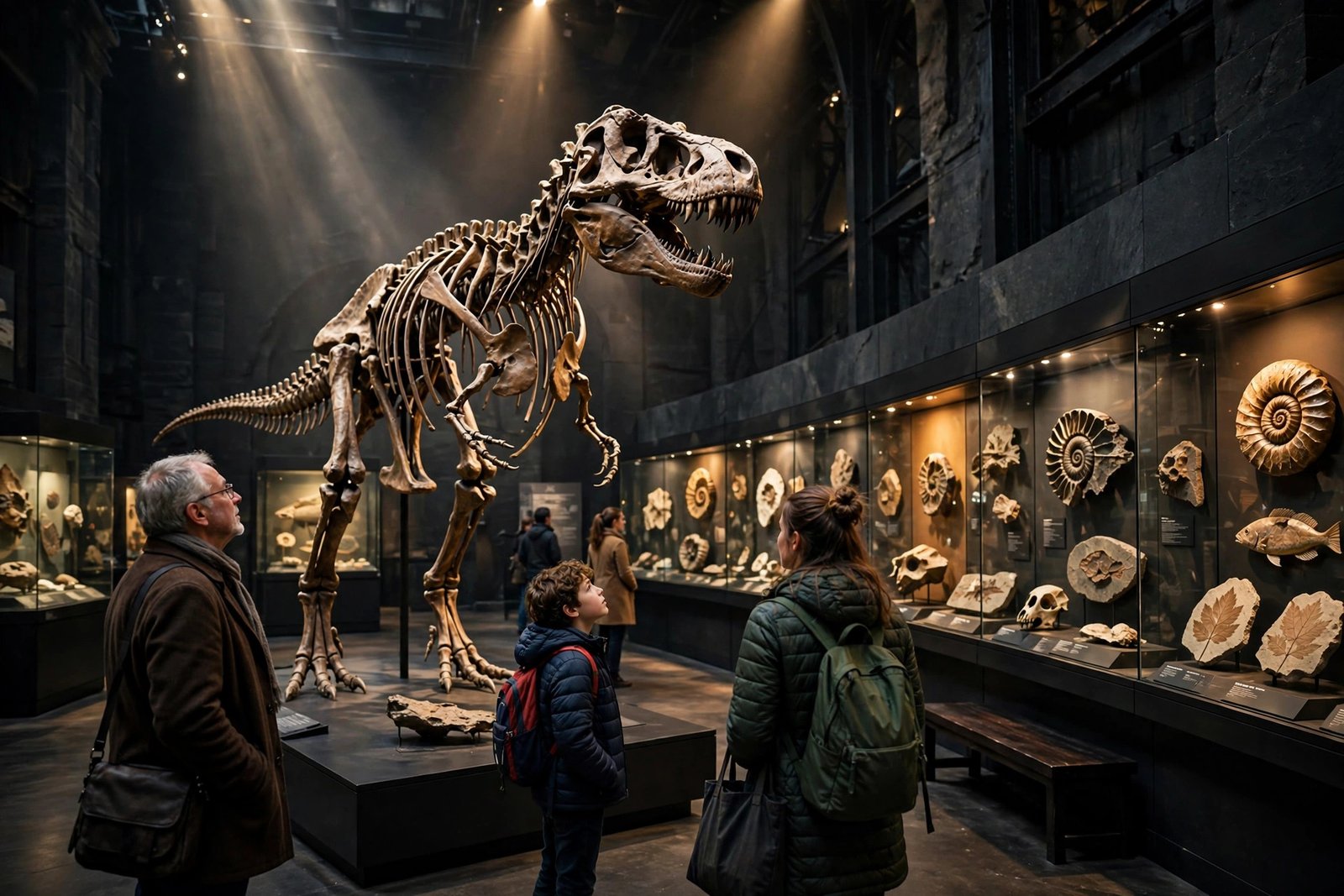
1. The fossil record: fossils appear in geological strata in exactly the order evolution predicts — simple organisms in ancient rocks, complex ones in recent rocks, with transitional forms (Tiktaalik: fish-to-tetrapod; Archaeopteryx: dinosaur-to-bird; the whale series showing nostrils migrating to blowholes) appearing at precisely the predicted times and places. Not a single fossil has ever been found in the “wrong” layer — a rabbit in Precambrian rock would falsify the theory overnight, and it has never happened.
2. DNA: the strongest evidence, unknown to Darwin. Humans share ~98.8% of DNA with chimpanzees, ~60% with bananas — the percentages matching precisely the relatedness predicted by anatomy and fossils. Endogenous retroviruses (viral DNA inserted at identical genome positions across species) are shared in patterns that only common ancestry explains — the probability of independent identical insertions is effectively zero. DNA also lets us predict discoveries: the fused human chromosome 2 (two ape chromosomes joined end-to-end, with the molecular scars of fusion visible) was predicted by common ancestry before it was observed.
3. Observed evolution: evolution is not just historical — it happens on human timescales. Bacteria evolving antibiotic resistance, insects evolving pesticide resistance, the peppered moth’s colour shift during industrial pollution (and reversal after clean-air laws), dog breeds diversifying from wolves in thousands of years, and Richard Lenski’s E. coli experiment evolving new traits over 75,000+ generations in the lab. Anyone who says “evolution has never been observed” is decades out of date.
4. Embryology and anatomy: human embryos develop (and then reabsorb) gill slits and tails; whales retain vestigial hip bones; flightless birds have wing stubs; humans have tailbones, appendixes, and goosebump muscles for fur we no longer have. These are the leftover architecture of ancestry — inexplicable under independent design, exactly predicted by descent with modification.
5. Biogeography: species distributions match evolutionary history, not just habitat suitability — marsupials dominate Australia (where they evolved in isolation) while placental mammals dominate elsewhere; islands have unique species related to the nearest mainland’s, not to similar islands far away. The pattern is ancestry plus geography, precisely as evolution predicts.
The misconceptions, corrected
“Humans came from monkeys”: humans and modern monkeys share a common ancestor ~25 million years ago — we are cousins, not descendants. Asking why monkeys still exist if we evolved from them is like asking why you have cousins if you descended from your grandparents. “It’s just a theory”: in science, “theory” means the highest-status explanation — gravity is “just a theory” too. Evolution is both fact (populations change over time — observed) and theory (natural selection explains how — overwhelmingly confirmed). “The eye is too complex to evolve”: Darwin himself addressed this — the eye evolved through functional intermediate stages, each advantageous, and we can trace the sequence from light-sensitive patches to camera eyes across living species. “Evolution can’t create information”: mutation creates variation (new information); selection preserves the functional kind — the two-step process generates complexity routinely, as demonstrated in both nature and genetic algorithms. “There are no transitional fossils”: there are thousands — the claim persists only by moving the goalposts (each new transitional form creates two new “gaps”). Darwin’s own letters show him predicting such finds, collected by the Darwin Correspondence Project at Cambridge University.
Humans and evolution
Humans evolved in Africa over ~6 million years from a common ancestor with chimpanzees, with multiple hominin species coexisting (we are the last surviving human species — Neanderthals, Denisovans, and others are extinct, though most non-Africans carry 1–2% Neanderthal DNA from ancient interbreeding). Key developments: bipedalism first (~4 million years ago), then brain expansion, tool use, fire, language, and agriculture — each building on the last. And evolution has not stopped: humans continue evolving — lactose tolerance spreading in pastoral populations within the last few thousand years, altitude adaptations in Tibetans and Andeans, disease-resistance variants. We are not evolution’s endpoint; we are its current draft. Understanding our biological heritage informs medicine too — preparing for health checks is more meaningful when you understand the evolved body being checked.
Why it matters (beyond the classroom)
Evolution is not abstract philosophy — it is practical infrastructure. Medicine: antibiotic stewardship, vaccine design (flu vaccines track viral evolution yearly), cancer treatment (tumours evolve resistance — oncology is applied evolutionary biology). Agriculture: crop breeding, pest management (pesticide resistance is evolution in action). Conservation: understanding how species adapt (or fail to) under climate change. Pandemics: SARS-CoV-2’s variants were evolution observed in real time, and public health responses that ignored evolutionary dynamics failed predictably. Denying evolution does not stop it operating — it just stops you from using humanity’s most powerful biological framework. The Natural History Museum’s evolution resources present the evidence accessibly for all ages.
Conclusion
Evolution in simple terms: individuals vary, the better-suited survive and reproduce more, offspring inherit the advantageous variations, and over deep time this changes populations into new species. The evidence converges from fossils (in exactly the predicted order), DNA (shared retroviruses, fused chromosomes, matching percentages), observed evolution (antibiotic resistance to lab E. coli), vestigial anatomy, and biogeography — five independent lines, one conclusion. Humans are African apes, evolution’s current draft, still evolving. The misconceptions dissolve on contact with the actual theory, which is more elegant than the cartoon. Darwin’s dangerous idea turned out to be biology’s beautiful one.
Frequently Asked Questions
What is evolution in simple terms?
Individuals in a species vary; those with variations better suited to the environment survive and reproduce more; offspring inherit those variations. Over many generations, populations change — and over millions of years, new species emerge. Variation, selection, inheritance, time.
Did humans evolve from monkeys?
No — humans and modern monkeys share a common ancestor around 25 million years ago. We are evolutionary cousins, not descendants. Multiple human species coexisted in the past; Homo sapiens is the last surviving one.
What is the strongest evidence for evolution?
DNA: shared endogenous retroviruses at identical genome positions, the fused human chromosome 2, and genetic relatedness percentages matching fossil and anatomical predictions exactly. Combined with fossils in precisely predicted strata and directly observed evolution, the case is conclusive.
Is evolution still happening?
Yes — antibiotic resistance, pesticide resistance, lactose tolerance spreading in human populations, and altitude adaptations are all evolution on observable timescales. SARS-CoV-2’s variants were evolution watched in real time.