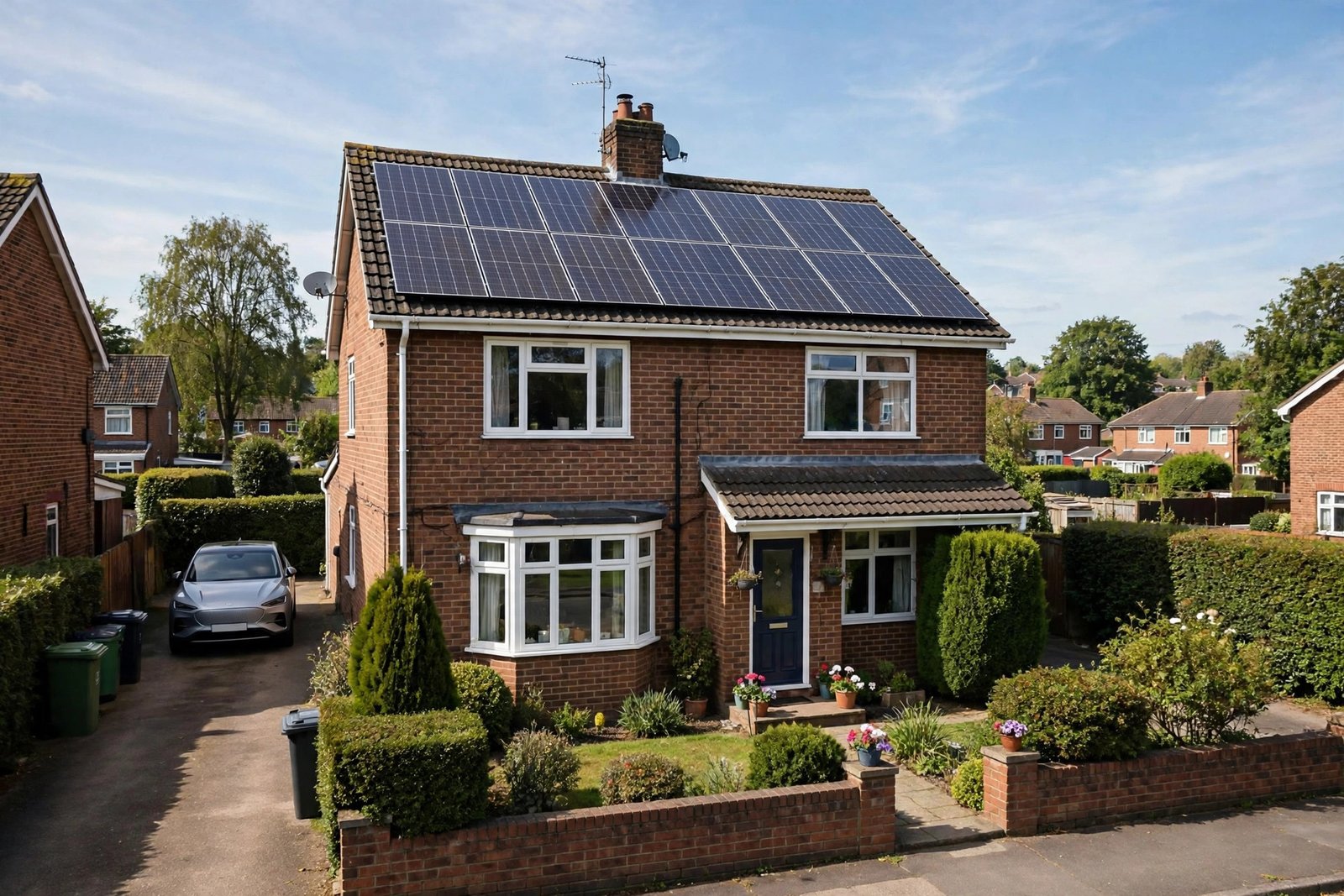
Rooftop glass looks passive on a grey morning, yet inside each panel a quiet electrical separation never stops working.
Layered Silicon and the Freed Electron
A solar panel is best pictured as a carefully layered sandwich. Its working heart is silicon, the same family of material used in computer chips, arranged in layers that have been treated to behave differently. One layer carries an abundance of free electrons, particles with a negative charge. The neighbouring layer is short of electrons, leaving gaps that behave as if they were positive charges waiting to be filled. Where the layers meet, an electric field forms, like a slope built into the material itself.
Light arriving from the sun carries energy in small packets. When a packet of light energy arrives with enough force, it can dislodge an electron from its atom, freeing it to move. Left alone, freed electrons and the gaps they leave behind would simply recombine at random, wasting the energy as heat. The built in field prevents that waste by sweeping the two apart in opposite directions, electrons toward one side and gaps effectively toward the other, creating the separation that electricity requires.
Metal contacts printed across the cell collect the separated charges and offer them a path. Give that path an external circuit and the electrons flow through it to reunite with gaps on the far side, doing work along the way. Reference explanations of nuclear fusion progress for curious beginners cover a very different way of harvesting energy from nature, yet the comparison helps beginners see that solar power is not combustion or magic. It is order imposed on tiny charges, repeated across millions of cells wired together into the familiar dark rectangles on a roof.
From Direct Flow to Household Current
The flow a cell produces is direct current, always moving in one direction, like water running steadily downhill. Homes, however, run on alternating current, which reverses direction in a regular rhythm and suits the national grid and ordinary appliances. Bridging those two worlds is the job of the inverter, a box of electronics usually mounted in a loft, garage or utility space, humming quietly while it performs the conversion thousands of times in a continuous, controlled pattern.
The inverter does more than translate. It constantly adjusts how much power it draws from the panels, hunting for the operating point where their output is greatest under the light available at that moment. Passing cloud changes that point repeatedly through a day, so the hunting never truly stops. The inverter also watches the grid for safety, disconnecting if the supply fails so that exported power cannot endanger engineers repairing lines outside, a protective duty built into its certification.
Descriptions under the heading of solar panels and household generation present a panel as a device converting sunlight into electricity through photovoltaic cells, typically made from silicon. That summary is accurate, though it hides the elegance of the partnership between panel and inverter. The panel is a patient gatherer, the inverter an alert manager, and the household wiring simply receives the result as ordinary mains electricity, indistinguishable from grid supply once converted, ready for kettles, laptops, washing machines and lights without any of them knowing a roof was involved at all.
Batteries Evening Use and Surplus Export
Generation and appetite rarely keep the same hours. Panels produce most strongly around the middle of the day, when many households are out, while demand peaks in the evening when cooking, lighting and entertainment coincide with darkness. Without storage, the midday surplus flows outward to the grid through the meter, and the household buys electricity back later, which works perfectly well but leaves the pleasing idea of using your own sunshine after dark unrealised.
A battery closes that gap in time. Surplus electricity charges it during bright hours, and when household demand exceeds what the panels supply, the stored energy discharges to cover the difference. The battery does not create energy, it merely moves energy across the day, and some is lost in the moving, as with any storage. Even so, households whose routines leave them out all day often find that shifting matters more to them than squeezing out the absolute maximum generation at noon.
Export remains part of the picture for most systems. On bright summer days a battery fills early and the house still has more than it needs, so the excess travels to neighbours through the grid, reducing the fossil generation required elsewhere. Monitoring applications make these flows visible, showing generation, consumption, storage and export as moving figures through the day. Watching them becomes surprisingly absorbing, and many owners find their habits adjusting almost unconsciously, running the dishwasher when the roof is busy rather than when habit alone would suggest.
Shade Season and Roof Direction Effects
Panels answer to light, not to heat, which surprises people who assume a scorching day must be ideal. In fact cells generally perform a touch more efficiently when cool, so a bright, breezy spring day can outproduce a still, sweltering one at the same light level. Cloud reduces output without ending it, because diffuse light scattered through cloud still arrives at the panel, weaker but usable, which is why generation graphs sag on overcast days rather than falling to nothing whenever the sun hides.
Season transforms the picture more than weather does. Long summer days with a high sun deliver abundantly, while short winter days with a low sun and frequent cloud deliver modestly, and no honest installer pretends otherwise. Direction matters too. A south facing roof in Britain catches the most over a year, east and west facing roofs spread generation toward morning and evening respectively, and north facing slopes receive so little direct light that they are usually considered poor candidates for panels at all.
Shade is the quiet saboteur. A chimney shadow, a growing tree or a neighbouring extension can drag down the output of connected cells, because cells wired in a string share the fortunes of their weakest member. Modern designs soften the problem with electronics that let panels work more independently, yet the cheapest shade remedy remains planning. Surveying shadows across seasons before installation, rather than discovering them afterwards, separates satisfied owners from disappointed ones more reliably than any difference between panel brands on the market.
Matching Generation to Real Household Habits
The reference description of a solar cells converting light into electricity calls the cell an electrical device converting light energy directly through the photovoltaic effect. Direct is the operative word for household planning as well. Electricity is cheapest to use at the moment it is made, so the smartest systems are sized and arranged around real habits rather than around the largest roof filling array a company can sell to an enthusiastic homeowner.
Practical matching looks like this in daily life. Heavy appliances run in sequence during bright hours instead of all at once in the evening. Hot water may be diverted to an immersion heater when surplus appears. Electric vehicles charge at midday where routines allow. None of these habits requires obsession, and households that approach them lightly, guided by a simple generation display, capture most of the benefit without turning domestic life into an energy management job with unpaid overtime.
Seen whole, a rooftop system is a small negotiation between sky, silicon and routine. The physics is fixed and beautiful, electrons freed by light and herded by a field into useful flow, but the value realised depends on human patterns laid over that physics. Understand the layers, respect the seasons, store what you can, use what you make while it is being made, and the passive looking glass on the roof reveals itself as the hardest working surface of the house, quiet, patient and busy whenever daylight bothers to show up.
Maintenance, happily, is modest compared with most household machinery. Panels have no moving parts to wear out, and rain does much of the cleaning in the British climate, washing dust and pollen from tilted glass before deposits can build into a serious shade of their own. An occasional check that no new shadow has crept across the array from a growing hedge, plus a glance at the generation figures to confirm the system is behaving as the season suggests, covers the bulk of what ownership asks of a household in practice.
The generation figures themselves become a quiet education over the years. Owners learn their roof the way gardeners learn a plot, knowing which months flatter it, which weeks disappoint, and how a single bright cold spell in spring can feel like a small lottery win on the monitoring screen. That familiarity breeds realistic expectations, and realistic expectations are the true foundation of satisfaction with any technology that depends on the weather for its working material and the sky for its schedule.
There is a wider satisfaction available too, harder to graph but easy to feel. A household generating electricity on its own roof participates directly in a national shift that otherwise arrives as abstract news. The physics on the roof is the same physics described in textbooks, electrons freed by light and guided by a built in field, yet ownership turns that abstraction into warm water, charged devices and a spinning sense of self reliance every time the sun bothers to appear over the rooftops of the street.
For readers weighing whether the technology suits their own roof, the deciding questions are refreshingly concrete. How much unshaded roof do you have, which way does it face, when does your household actually use electricity, and how long do you expect to stay in the house to enjoy the arrangement? A modest array matched thoughtfully to daytime habits can serve its owners better than a grand installation designed around a sales target. The physics rewards honesty about lifestyle just as surely as it rewards a favourable slope, a clear southern aspect and a complete absence of chimneys casting their long afternoon shadows across the glass.